Beyond Energy Storage: How New-Generation Storage Is Reshaping the Energy Landscape
author: HT infinitepower
2026-07-03
In recent years, as the global energy transition continues to deepen—particularly driven by the rapid surge in computing demand from large-scale AI model training—the momentum behind next-generation energy storage technologies, aiming for “greater safety, longer duration, and higher cost efficiency,” has been accelerating.
According to relevant data, global new installations of next-generation energy storage surpassed 113.3 GW in 2025, with cumulative installed capacity accounting for 56.2% of the electricity storage market. It is projected that by 2034, global cumulative energy storage capacity will reach 1,545 GW.
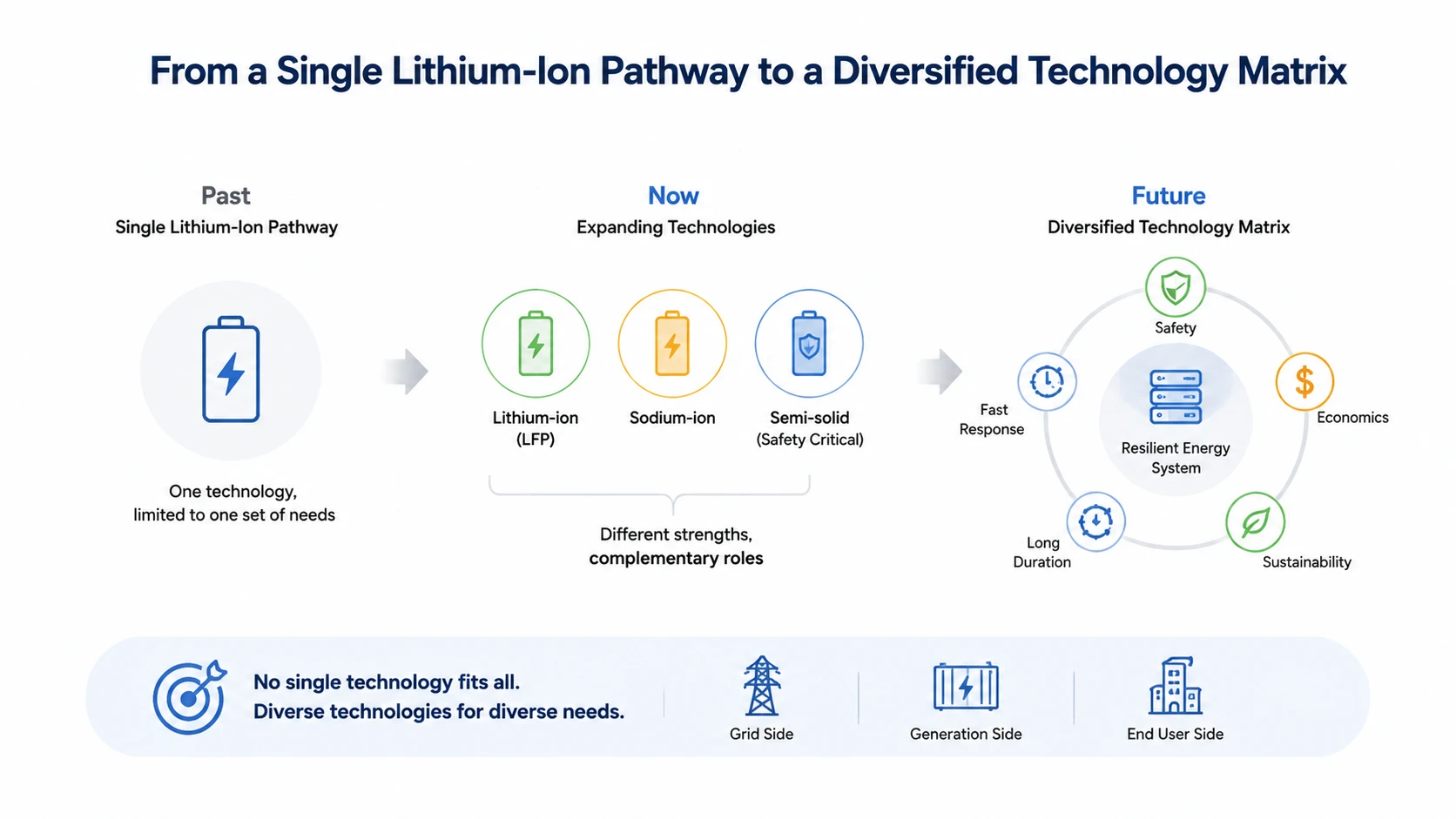
The industry is now moving from a lithium-ion battery–dominated landscape toward a new stage of diversified technological competition, where multiple storage technologies develop in parallel and complement each other. At the same time, application scenarios continue to expand and become increasingly diversified.
From a Single Lithium-Ion Pathway to a Diversified Technology Matrix
At present, global next-generation energy storage technologies are accelerating breakthroughs. For example, in China, a 200 MW / 400 MWh advanced electrochemical energy storage project has been successfully commissioned, driving the large-scale application of hybrid solid–liquid battery technologies to a new level. This project was selected as one of the “Top Ten Energy Technology Innovations of 2025” by China’s National Energy Administration.
In the United States, Google has entered into a strategic partnership with Form Energy to deploy ultra-long-duration, high-safety iron-air batteries into data center power systems, offering a new solution for energy infrastructure in the AI era.
In Japan, South Korea, and the European Union, solid-state batteries are widely regarded as a key technology that could reshape the future energy landscape. These regions are actively pursuing leadership in this field through policy support, capital investment, and coordinated industrial development.
Energy storage is a critical pillar of the modern power system, fundamentally transforming the traditional “instant generation and immediate consumption” model of electricity. Conventional storage technology has been dominated by pumped hydro storage. In contrast, new-type energy storage refers to all storage technologies that output electricity, excluding pumped hydro.
Compared with pumped hydro, new energy storage technologies offer shorter construction periods, greater site flexibility, faster response times, stronger grid regulation capability, and better compatibility with renewable energy integration. They can be deployed in a distributed manner across the generation side, grid side, and end-user side, deeply embedding themselves into every layer of the power system.
From a technical perspective, new energy storage can be broadly divided into two categories: electrochemical storage and physical storage. Electrochemical storage relies on internal chemical reactions within batteries to store and release energy, offering fast response and flexible deployment. Physical storage, on the other hand, stores energy in media such as air, water, or thermal systems, making it more suitable for large-scale, long-duration applications.
Over the past decade, liquid lithium-ion batteries have dominated the electrochemical storage market due to their high energy density and mature supply chain, accounting for more than 96% of new energy storage installations. However, as real-world demand continues to grow rapidly, the expectations placed on storage technologies have expanded far beyond simply “storing electricity.” Instead, energy storage systems are now expected to function as versatile assets that can simultaneously meet complex power system requirements across safety, economics, resource efficiency, lifespan, and duration.
In the face of these multi-dimensional objectives, no single technology can serve all scenarios. Instead, the industry is moving toward a diversified technology matrix that spans multiple time scales—from millisecond-level response to seasonal storage—and a wide range of application needs.
Electrochemical and Physical Energy Storage: Each Technology Excels in Its Own Way
In the field of electrochemical energy storage, new technological pathways such as solid-state batteries, sodium-ion batteries, flow batteries, and iron-air batteries are emerging rapidly, each demonstrating distinct advantages.
Solid-state batteries are currently regarded as the “ideal form” of next-generation energy storage and represent a key direction for high-performance battery development. Unlike conventional lithium-ion batteries that use liquid electrolytes, solid-state batteries rely on solid electrolytes to conduct ions, fundamentally reducing the risk of fire and thermal runaway. In addition, solid-state batteries can potentially be paired with lithium-metal anodes, further increasing energy density.
Semi-solid (hybrid solid–liquid) lithium batteries developed by the Institute of Physics, Chinese Academy of Sciences and Welion New Energy have already achieved large-scale grid-level deployment in the energy storage sector. Fully solid-state batteries are expected to enter commercialization around 2028. Companies such as Toyota in Japan, Samsung in South Korea, and Solid Power in the United States are also accelerating R&D efforts and pushing toward scalable mass production. Breakthroughs in material cost and manufacturing processes for solid-state batteries are expected to significantly reshape the future landscape of both large-scale energy storage and electric vehicles.
As a “complementary counterpart” to lithium batteries, sodium-ion batteries have attracted significant industry attention. Sodium shares similar chemical properties with lithium but is far more abundant and widely distributed in nature, often referred to as a “low-cost abundant resource.” Moreover, sodium-ion batteries maintain stable performance across a wide temperature range from -30°C to 50°C, making them highly promising for energy storage in cold regions, grid peak shaving, and telecom base stations.
The Institute of Physics, Chinese Academy of Sciences, together with HiNa Battery Technology, has established a production line and demonstrated sodium-ion energy storage systems at the 100 MWh scale. French company Tiamat is also focusing on fast-charging sodium-ion technology for both transportation and energy storage applications.
In recent years, flow battery commercialization has also accelerated significantly. Unlike conventional batteries that store energy within the electrodes, flow batteries store energy in external electrolytes, offering long lifespan and high safety, making them particularly suitable for large-scale, long-duration storage applications. In China, the Dalian Flow Battery Energy Storage Peak-Shaving Power Station—currently the world’s largest vanadium flow battery project—has been successfully commissioned, with Phase I reaching 100 MW / 400 MWh.
The U.S. Department of Energy continues to support flow battery R&D and demonstration projects, aiming to advance long-duration storage technologies. Countries such as Australia are also actively integrating flow batteries into renewable energy hub projects.
Iron-air batteries store energy through a reversible “rusting and de-rusting” process. During discharge, the battery absorbs oxygen from the air and oxidizes iron into rust; during charging, the rust is converted back into iron while oxygen is released. While conventional lithium-ion batteries typically provide 2–10 hours of storage duration, iron-air batteries can deliver extremely long discharge times of up to 100 hours.
With low-cost iron as the primary material and inherently high safety, the key challenges lie in electrode innovation and electrolyte optimization. The U.S. Department of Energy has identified iron-air technology as a priority research area, aiming to provide multi-day power support for the grid under extreme weather conditions.
In the field of physical energy storage, various technologies are also advancing in parallel. Compressed air energy storage uses surplus electricity to compress air and store it in underground caverns, releasing it later to drive turbines for power generation. Flywheel energy storage stores kinetic energy through high-speed rotating rotors and is known for its strong power output capability. Thermal energy storage technologies such as molten salt systems store heat for later use in power generation or cooling applications.
China’s independently developed advanced compressed air energy storage systems continue to break records in single-unit capacity. Meanwhile, the United States and Europe are actively exploring adiabatic compressed air storage systems integrated with wind and solar power.
Overall, different energy storage technologies are gradually forming a differentiated and complementary landscape. Short-duration applications (within 30 minutes) are mainly served by flywheels, supercapacitors, and high-power lithium-ion batteries. Medium-duration storage (within 10 hours) is currently dominated by lithium-ion batteries, which are evolving toward safer hybrid solid–liquid and solid-state technologies, while sodium-ion batteries are also developing rapidly due to their resource advantages.
Long-duration storage on the generation and grid side is supported by flow batteries, compressed air energy storage, iron-air batteries, and thermal storage technologies such as molten salt systems for heating and cooling. Together, these diversified technologies form a complementary ecosystem, providing comprehensive technical support for the development of a modern power system.
Accelerating Toward Large-Scale Commercial Deployment
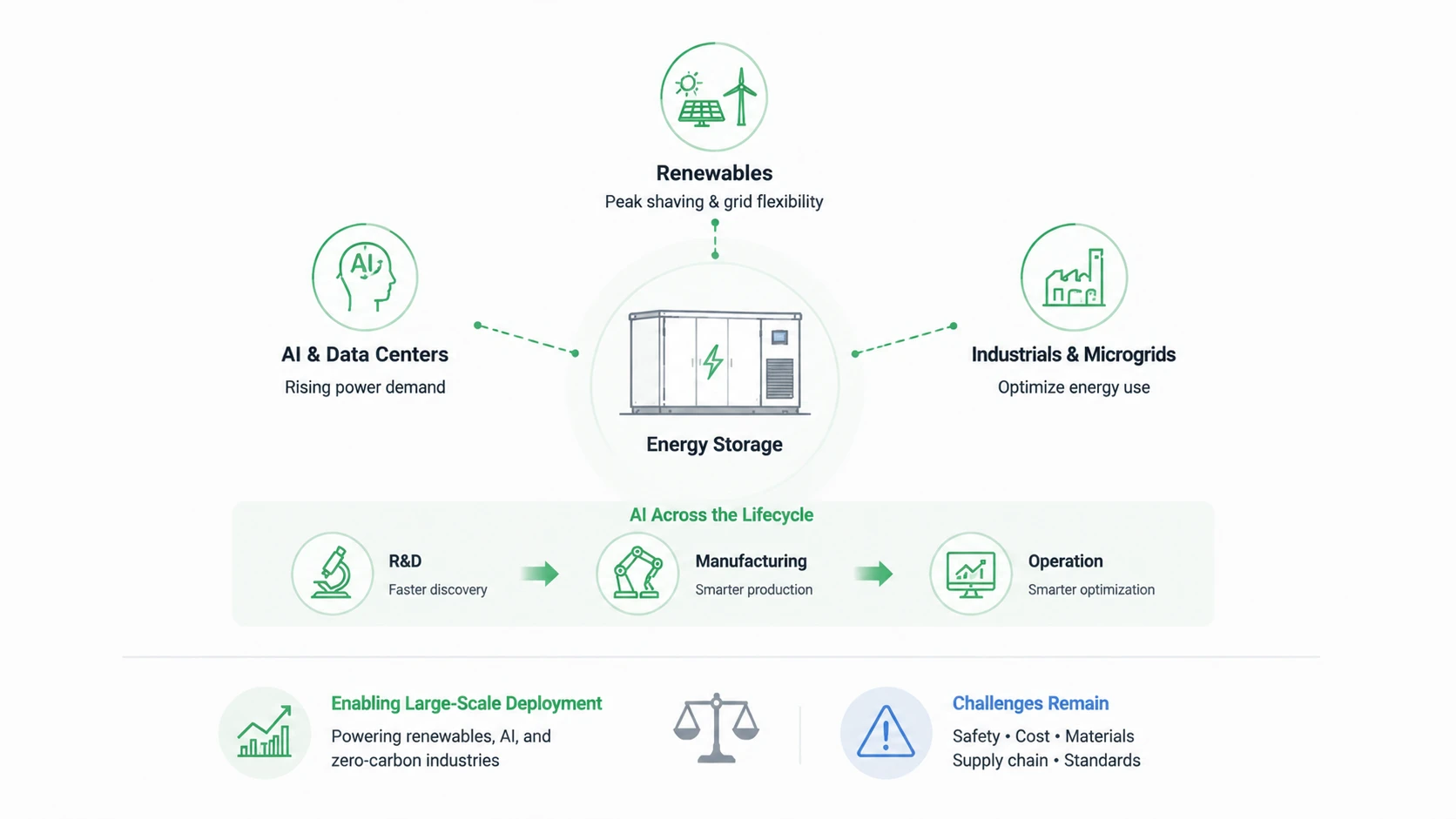
As technologies continue to mature, next-generation energy storage is transitioning from demonstration projects to large-scale commercial deployment, gradually integrating into power systems, industrial production, and the digital economy.
Renewable energy generation is currently the most important application scenario. Energy storage enables surplus electricity to be stored and released during peak demand periods, effectively supporting peak shaving and valley filling, and providing critical flexibility for grids with high renewable penetration.
Artificial intelligence is emerging as a new driver of storage demand growth. The rapid increase in electricity consumption from large-scale model training and AI computing centers has led major tech companies such as Google, Microsoft, Meta, and Amazon to actively invest in long-duration energy storage projects. As a result, energy storage is becoming a foundational enabler of the AI era.
At the same time, energy storage is rapidly expanding into industrial parks, zero-carbon campuses, green buildings, and remote microgrids. It helps enterprises optimize energy consumption structures, improve energy self-sufficiency, and reduce dependence on fossil fuels.
AI is also increasingly involved across the entire lifecycle of energy storage—from R&D to manufacturing and operation. In the research stage, AI can rapidly screen and predict material performance, significantly shortening battery development cycles. In manufacturing, digital twins and machine vision technologies are driving the industry toward smarter and more automated production. In operational management, AI enables real-time monitoring of system conditions, prediction of degradation and safety risks, and dynamic optimization of charge-discharge strategies based on weather conditions, load profiles, and electricity prices.
From technological breakthroughs in laboratories to critical infrastructure supporting renewable power systems, AI computing centers, and zero-carbon industrial parks, energy storage is accelerating toward large-scale deployment.
However, several key challenges remain. From a technical perspective, core objectives such as safety, long cycle life, and low cost have not yet been fully achieved. From an industrial perspective, further development is needed in supply chains for key materials, equipment manufacturing, recycling systems, market regulations, and technical standards.
Looking ahead, as multiple technology pathways continue to mature, a more flexible, efficient, and low-carbon energy system is expected to gradually take shape—marking a new chapter in the global energy transition.
How to Design a Commercial Battery Energy Storage System: A Step-by-Step Engineering Guide
Mining’s New Power Backbone: The Rise of On-Site Energy Storage