Why Most Energy Storage Systems Never Use 100% DOD ?
2026-05-27
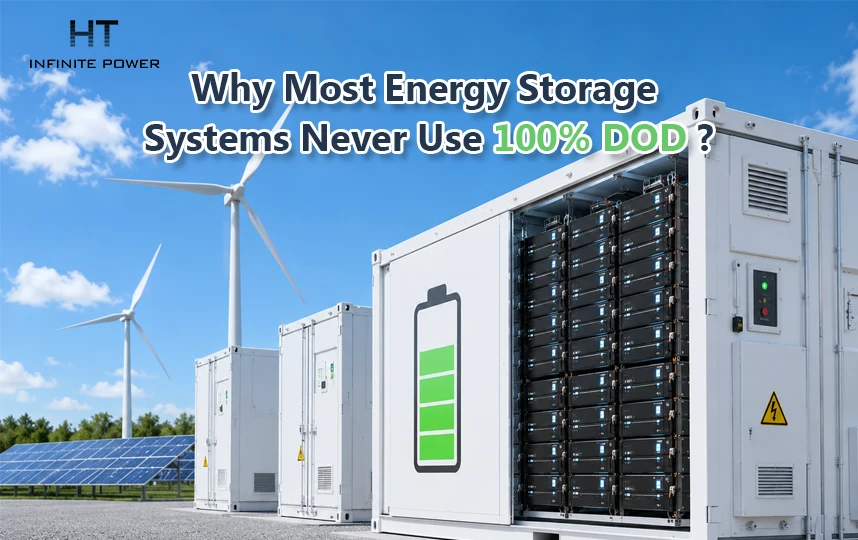
A common assumption in battery energy storage is that higher usable capacity automatically leads to better project economics. On paper, a system capable of 100% depth of discharge sounds ideal. More energy released per cycle should mean higher utilization, stronger revenue potential, and better return on investment.
But real-world storage projects rarely operate that way.
Across utility-scale battery containers, commercial and industrial storage systems, and even large renewable integration projects, operators almost never allow lithium batteries to fully discharge. In fact, many systems deliberately lock away part of the battery capacity through software restrictions, typically keeping the operating window somewhere around 10%–90% SOC.
At first glance, this seems contradictory. Developers spend millions on storage assets, yet intentionally avoid using part of the battery they already paid for.
The reason has very little to do with theoretical battery capability. Modern lithium battery systems can technically achieve 100% DOD. The real issue is what happens to the battery after repeated deep discharge cycles begin accumulating over years of operation.
Once storage moves from the laboratory into commercial deployment, the discussion changes completely. The industry stops asking how much energy a battery can release once and starts asking how much energy it can reliably deliver over its entire service life.
That distinction is where DOD strategy becomes one of the most important decisions in energy storage design.
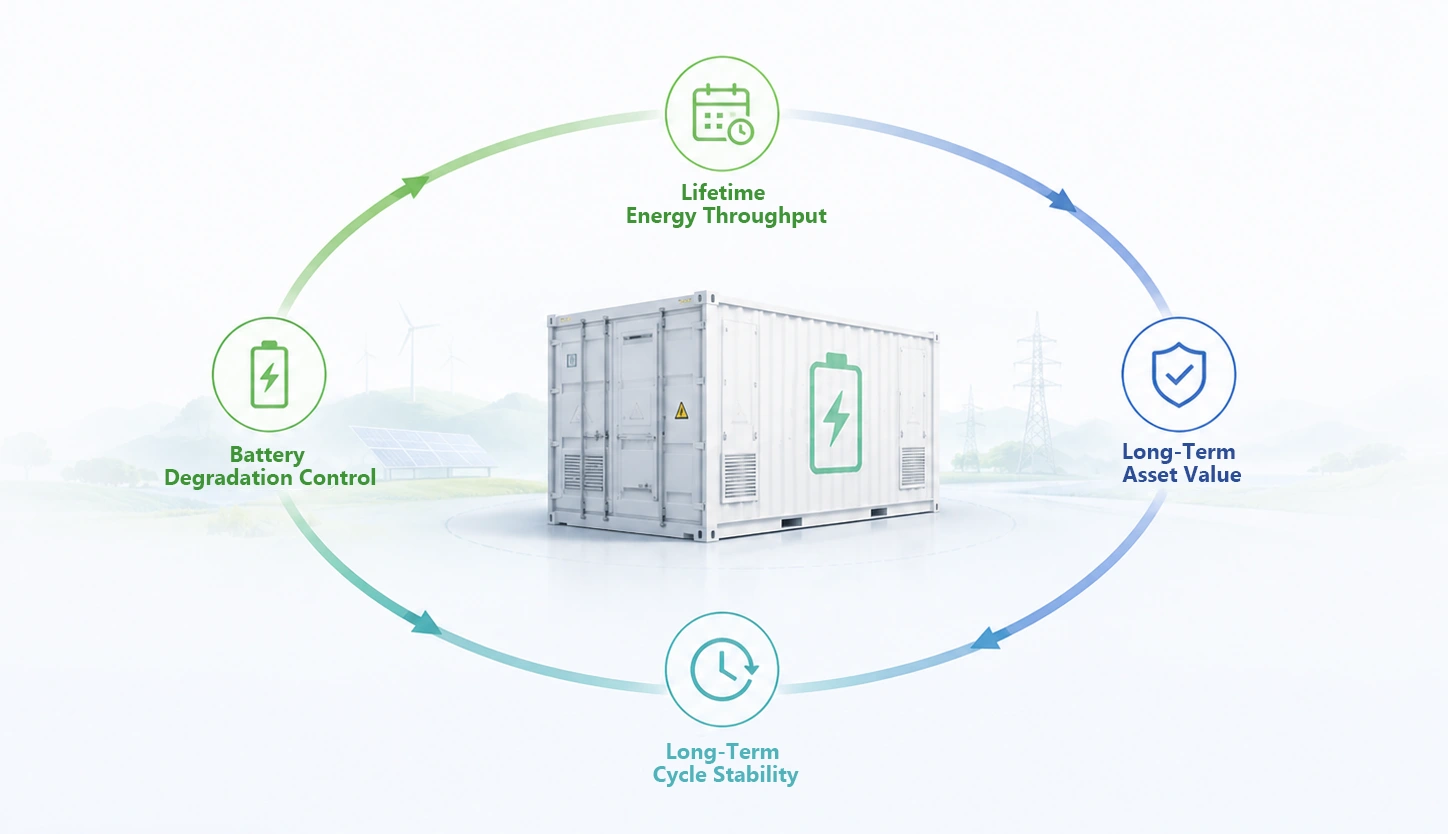
The industry is optimizing lifetime energy throughput, not single-cycle output
In battery marketing materials, maximum capacity often receives the most attention. But operators and investors look at a very different metric: total lifetime energy throughput.
A storage container is not designed to win a one-time performance test. It is expected to cycle thousands of times across ten or even fifteen years while maintaining predictable degradation rates, thermal stability, and acceptable maintenance costs.
 This changes the economics entirely.
A battery discharged to 100% DOD may release more energy in a single cycle, but repeated deep discharge places significantly greater stress on the electrochemical system. Over time, that stress accelerates aging mechanisms inside the cell, shortening usable lifespan and reducing the total amount of energy the battery can ultimately deliver before replacement becomes necessary.
This is why many experienced storage integrators no longer view maximum DOD as a performance advantage. In many cases, it actually reduces the long-term value of the asset.
The difference becomes especially important in utility-scale projects where profitability depends on cycle consistency over many years rather than aggressive short-term output.
Why deep discharge accelerates battery aging
The technical side of this issue starts inside the electrodes themselves.
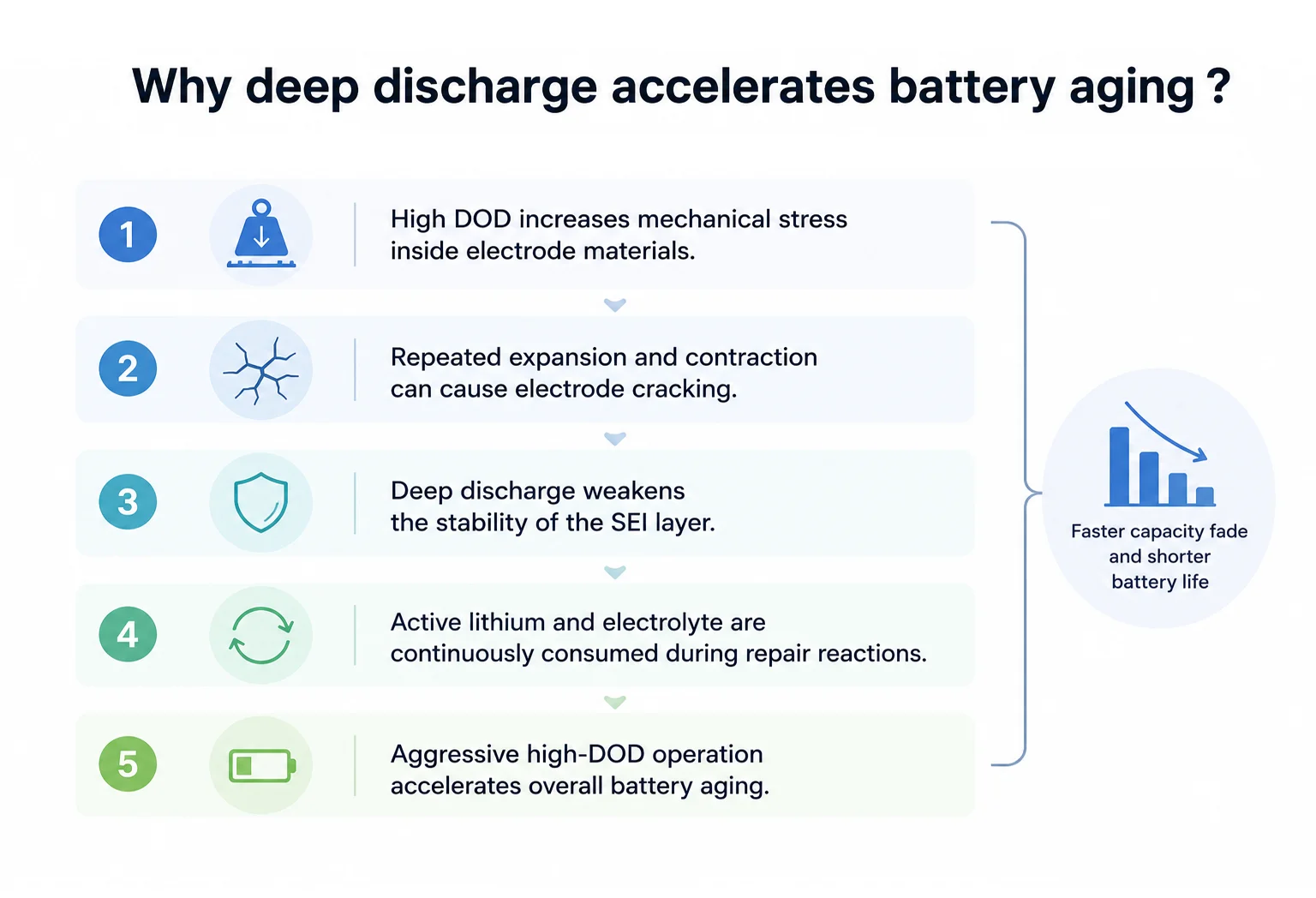
During charge and discharge, lithium ions continuously move between the cathode and anode. Under high DOD conditions, that ion movement becomes more extreme. Electrode materials repeatedly expand and contract as larger quantities of lithium are inserted and extracted from the crystal structure.
At moderate operating ranges, modern lithium iron phosphate batteries can manage this stress relatively well. But once discharge depth consistently approaches 100%, the mechanical strain becomes much more severe.
Over time, microscopic cracking begins developing inside the electrode materials. These structural changes reduce the battery’s ability to store and transport lithium efficiently, accelerating irreversible capacity loss.
At the same time, another critical problem develops at the anode interface.
Lithium-ion batteries rely on a thin protective layer known as the solid electrolyte interphase, or SEI film. This layer stabilizes reactions between the electrolyte and the anode surface. Under excessive deep discharge conditions, the anode voltage can fall too low, destabilizing the SEI layer and triggering additional side reactions inside the cell.
Lithium-ion batteries rely on a thin protective layer known as the solid electrolyte interphase, or SEI film. This layer stabilizes reactions between the electrolyte and the anode surface. Under excessive deep discharge conditions, the anode voltage can fall too low, destabilizing the SEI layer and triggering additional side reactions inside the cell.
The battery then consumes active lithium and electrolyte in an attempt to rebuild the damaged interface.
That process permanently reduces available lithium inventory.
In other words, the battery is slowly sacrificing part of itself just to maintain internal stability.
This is one of the main reasons why aggressive DOD strategies tend to accelerate degradation much faster than many operators initially expect.
The problem becomes worse in cold environments
Temperature adds another layer of complexity.
In colder climates, lithium-ion mobility slows significantly. When deep discharge is combined with low-temperature operation, lithium ions struggle to insert smoothly into the anode structure during charging cycles.
Under these conditions, lithium plating becomes increasingly likely.
Instead of being stored properly inside the anode material, metallic lithium begins depositing on the anode surface. Over repeated cycles, this can form dendritic structures that grow through the separator.
At best, lithium plating reduces capacity and cycle life.
At worst, it creates internal short circuits capable of triggering thermal runaway events.
This is one reason why BMS strategies become far more conservative in cold-weather storage projects. Operators in northern regions or harsh winter climates often prioritize long-term stability over maximum discharge utilization because the safety margin becomes far more important under extreme environmental conditions.
The battery may technically support deeper discharge, but the operational risk profile changes dramatically once temperature stress is introduced.
More usable capacity does not always mean better economics
One of the biggest misconceptions in energy storage is the idea that higher DOD automatically improves project profitability.
In reality, the opposite is often true.
Consider a simplified lithium iron phosphate storage scenario.
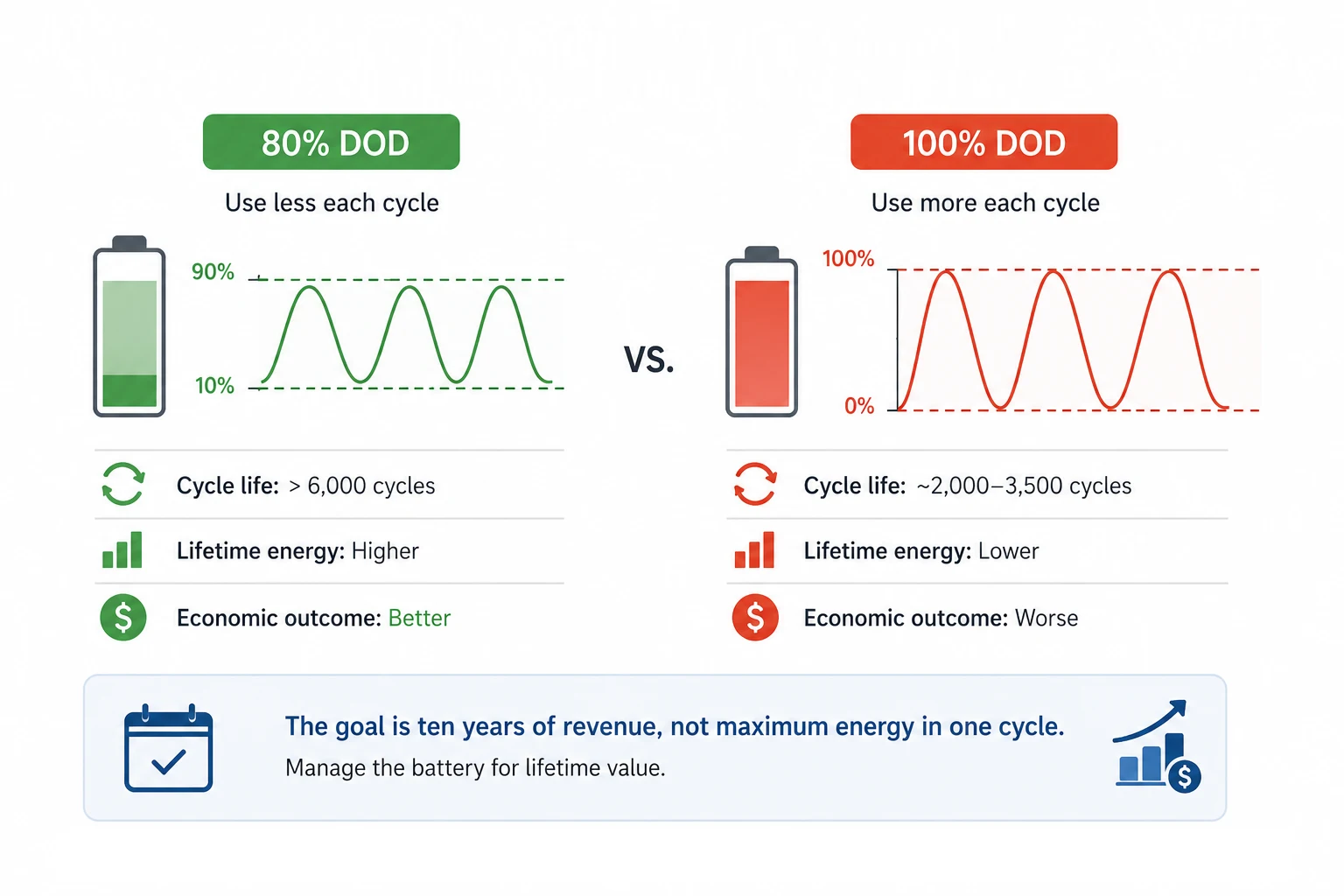
Under an 80% DOD strategy, the system may operate between roughly 90% SOC and 10% SOC. Although each cycle releases slightly less energy, the battery may achieve more than 6,000 cycles before reaching 80% state of health.
Under a 100% DOD strategy, the system extracts maximum energy per cycle, but cycle life may fall dramatically into the 2,000–3,500 cycle range.
The immediate energy output is higher.
The lifetime energy delivery is lower.
The lifetime energy delivery is lower.
That distinction matters enormously in commercial storage economics.
A battery asset generates value through cumulative throughput over years of operation. If aggressive discharge behavior forces premature replacement, the project loses economic efficiency even if short-term discharge capacity initially appears attractive.
This is why experienced storage operators focus heavily on lifecycle optimization rather than theoretical maximum utilization.
The battery is not being managed for one cycle.
It is being managed for ten years of revenue generation.
Why modern BMS platforms deliberately restrict DOD
This is where the battery management system becomes central to storage economics.
Many people think the BMS exists mainly for safety protection. In reality, modern BMS architecture also functions as a long-term asset management system.
Its job is not simply to prevent catastrophic failure. It is designed to optimize the balance between usable capacity, degradation speed, thermal behavior, warranty compliance, and long-term financial return.
That is why most storage systems intentionally reserve safety buffers at both high and low SOC levels.
The “unused” capacity is not wasted energy.
It is operational protection.
By restricting the battery away from extreme voltage ranges, the BMS reduces electrochemical stress, limits thermal accumulation, improves cell consistency, and slows degradation across the pack.
Under abnormal conditions, these restrictions become even stricter.
If temperatures fall too low, if cell imbalance increases, or if abnormal voltage behavior appears, the BMS may actively prevent further discharge regardless of theoretical remaining capacity.
This is not a limitation of the battery itself.
It is a deliberate operational strategy designed to protect long-term system stability.
The storage industry is moving away from specification-driven thinking
Over the past several years, the energy storage market has started shifting away from specification-focused evaluation.
Early projects often emphasized headline numbers:
- Maximum capacity
- Maximum DOD
- Maximum discharge rate
But large-scale operators increasingly care about different questions:
- How stable is the degradation curve?
- How much energy can the system deliver over ten years?
- How does the battery behave under partial cycling?
- What happens under high-temperature or low-temperature stress?
- How reliable is the warranty under real operating conditions?
These are much more difficult questions to answer, but they determine whether a storage project succeeds financially.
As a result, the industry has become more cautious about treating 100% DOD as a meaningful selling point.
In many advanced storage projects today, controlled operating strategy is viewed as more valuable than aggressive capacity utilization.
That shift reflects a broader maturation of the energy storage industry itself.
As a result, the industry has become more cautious about treating 100% DOD as a meaningful selling point.
In many advanced storage projects today, controlled operating strategy is viewed as more valuable than aggressive capacity utilization.
That shift reflects a broader maturation of the energy storage industry itself.
The real goal is controlled longevity
So, can an energy storage container achieve 100% DOD?
Technically, yes.
Commercially, however, most systems are intentionally designed not to operate that way.
Once long-term degradation, thermal stress, safety margins, and replacement economics are taken into account, unrestricted deep discharge becomes difficult to justify in real-world projects.
The storage industry has gradually learned that battery value is not determined by how much energy can be extracted once.
It is determined by how much stable, repeatable, economically useful energy the system can deliver across its entire operational life.
That is why modern BMS platforms continue limiting operational windows even as battery technology improves.
The goal is no longer maximum extraction.
It is controlled longevity.
Technically, yes.
Commercially, however, most systems are intentionally designed not to operate that way.
Once long-term degradation, thermal stress, safety margins, and replacement economics are taken into account, unrestricted deep discharge becomes difficult to justify in real-world projects.
The storage industry has gradually learned that battery value is not determined by how much energy can be extracted once.
It is determined by how much stable, repeatable, economically useful energy the system can deliver across its entire operational life.
That is why modern BMS platforms continue limiting operational windows even as battery technology improves.
The goal is no longer maximum extraction.
It is controlled longevity.
Why “Charge High, Discharge Low” and “Charge Low, Discharge High” Occur in Lithium Batteries
Solid-State Batteries: The Final Push Toward Mass Production