Why “Charge High, Discharge Low” and “Charge Low, Discharge High” Occur in Lithium Batteries
2026-06-01
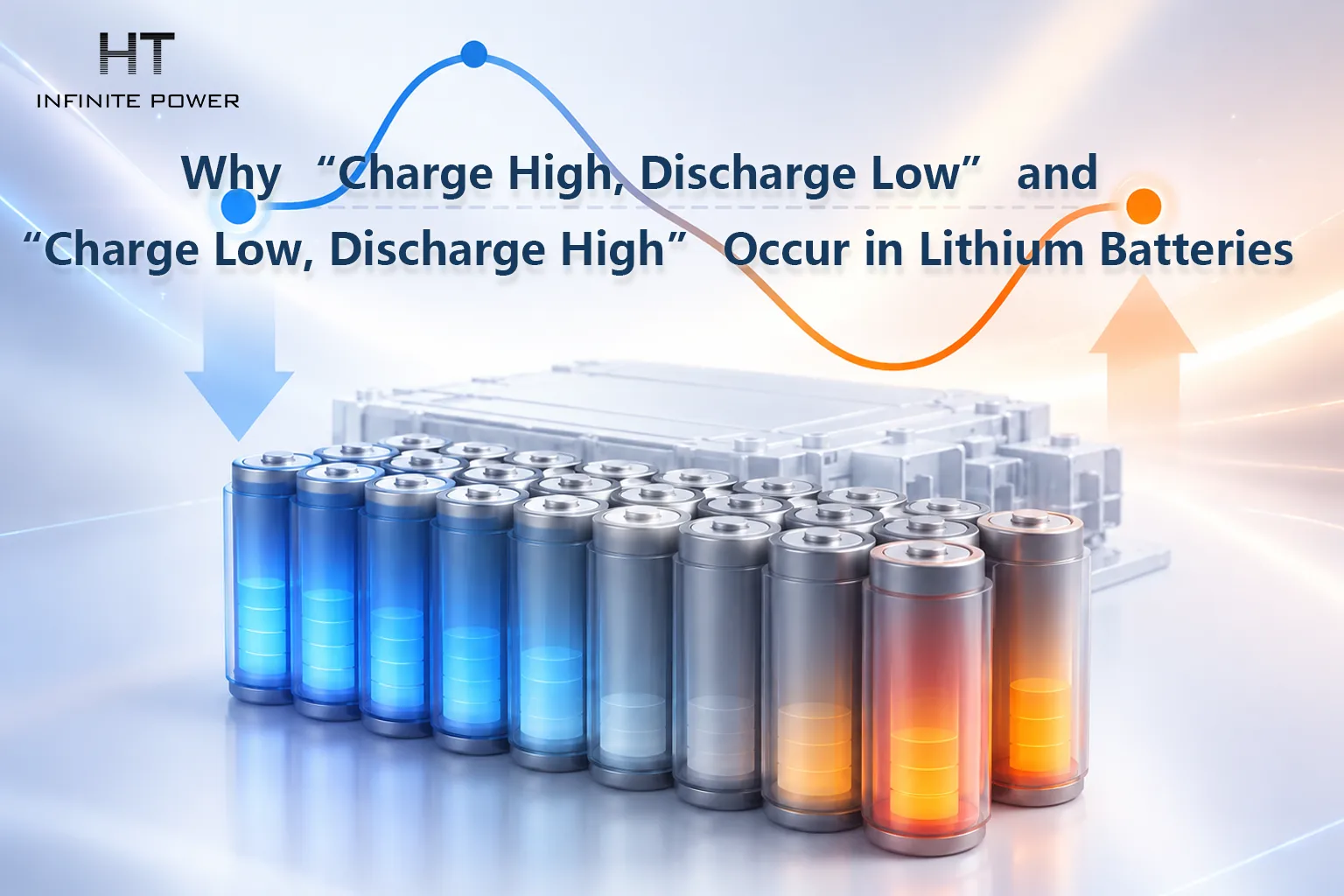
Anyone working with lithium battery packs long enough will eventually encounter a frustrating situation: the battery appears to charge more capacity than expected, yet delivers less energy during discharge. Sometimes the opposite happens — the pack seems difficult to fully charge, but discharge performance appears unusually high.
In the industry, these phenomena are often described as “charge high, discharge low” and “charge low, discharge high.”
At first glance, it looks like a simple capacity measurement issue. In reality, it usually reveals deeper inconsistencies inside the battery pack itself. Cell aging differences, internal resistance variation, temperature gradients, SOC estimation errors, and balancing strategy limitations can all contribute to these abnormal behaviors.
These issues are especially common in large lithium battery systems where dozens or even hundreds of cells operate together. Once inconsistency appears inside the pack, the entire system begins behaving according to its weakest cells rather than its nominal design capacity.
Understanding why this happens is important not only for troubleshooting customer complaints, but also for improving battery pack design, BMS strategy, and long-term reliability.
When the Battery Seems Full but Delivers Less Energy
“Charge high, discharge low” usually means the battery pack appears to accept more charge than its rated capacity, but the actual usable discharge energy is lower than expected.
For example, a 100Ah battery pack may display 105Ah during charging, yet only release 92–95Ah during discharge.
This is one of the most common field complaints in lithium battery systems, particularly after the pack has operated for a period of time.
The root cause is rarely a single failed cell. More often, it is the gradual divergence between cells inside the pack.
Some cells age faster than others. Their actual usable capacity drops earlier, even though the entire pack continues operating as one system. During charging, these weaker cells reach the upper voltage cutoff first. Once the BMS detects that threshold, charging stops for the entire pack.
The problem is that many other cells may still not be fully charged.
During discharge, the opposite occurs. The weaker cells empty first and hit the lower voltage protection limit earlier than the rest of the pack. Again, the BMS terminates discharge to protect the battery, leaving usable energy trapped in healthier cells.
The result is a pack that appears to consume more energy during charging than it can later deliver.
This “bucket effect” becomes increasingly obvious as battery systems scale larger. In utility-scale storage systems containing hundreds of series-connected cells, even small deviations in capacity or impedance can eventually reduce the usable energy window of the entire system.
Internal Resistance Differences Often Create Misleading Voltage Behavior
Capacity inconsistency is only part of the story.
In many real-world cases, internal resistance variation plays an even larger role.
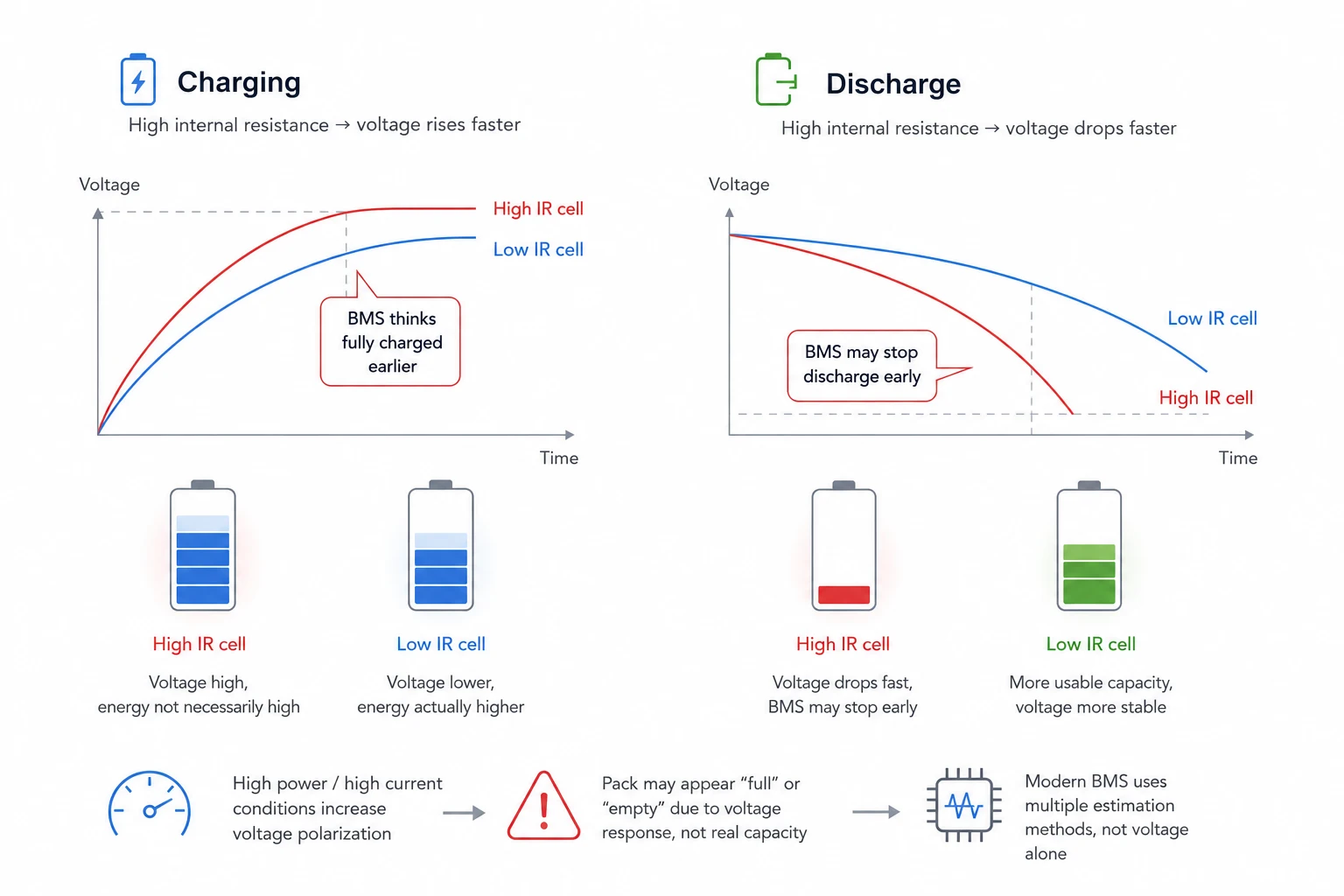
Cells with higher internal resistance experience faster voltage rise during charging. To the BMS, these cells appear fully charged earlier than they actually are. The voltage is high, but the stored energy is not necessarily high.
During discharge, high-resistance cells show sharper voltage drops under load. The BMS may interpret this as deep discharge and terminate output earlier than necessary.
This creates a misleading situation where voltage behavior no longer accurately reflects actual remaining capacity.
The issue becomes more severe in high-power applications such as fast charging systems, industrial ESS installations, and EV platforms operating under high current conditions. Under heavy load, voltage polarization increases significantly, making SOC estimation more difficult.
A battery pack can therefore appear “full” or “empty” primarily because of voltage response rather than real electrochemical capacity.
This is one reason modern battery management systems increasingly combine multiple estimation methods instead of relying solely on voltage.
Why “Charge Low, Discharge High” Also Happens
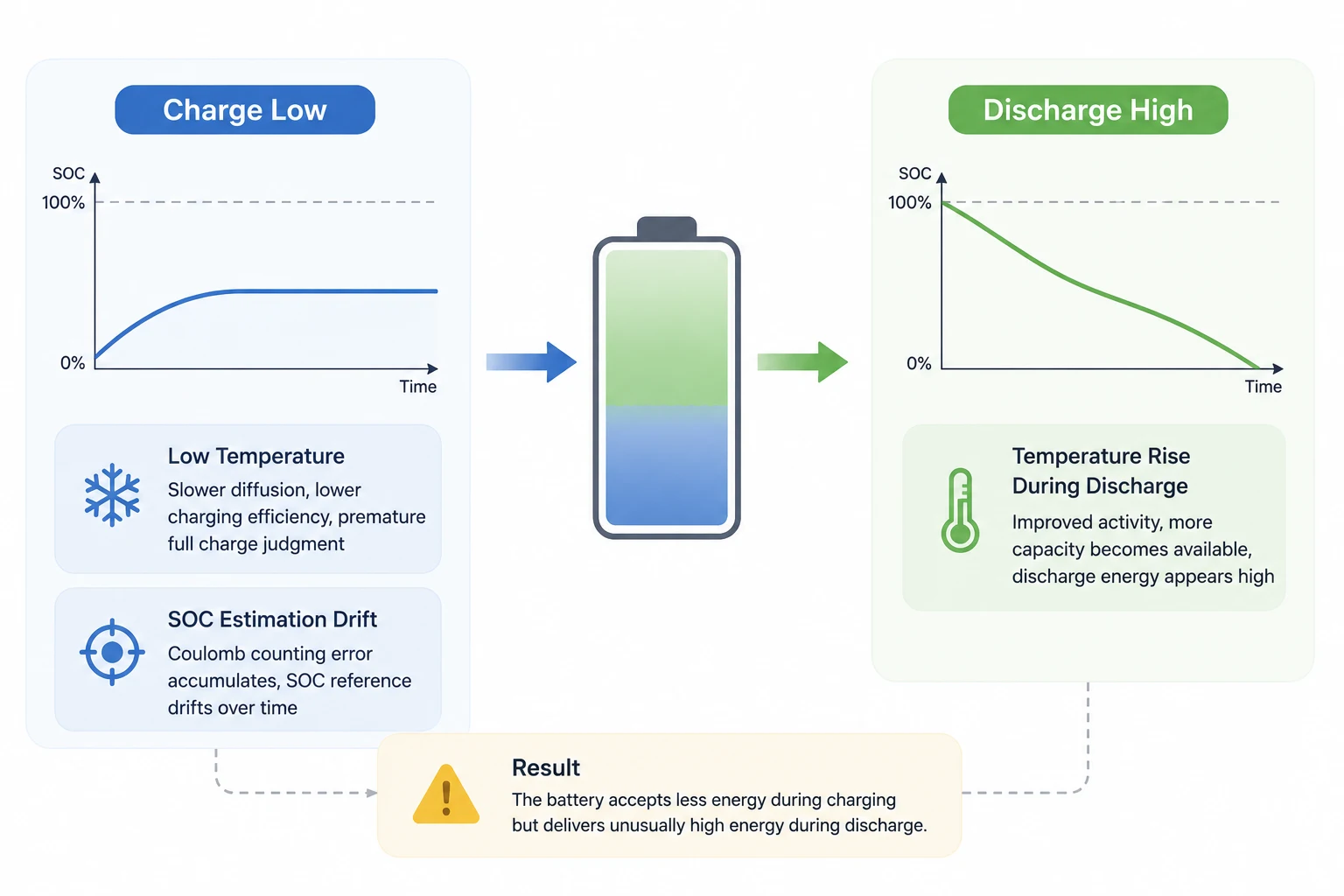
The opposite condition — “charge low, discharge high” — sounds less problematic, but it often indicates inaccurate SOC estimation or abnormal operating conditions.
In this case, the battery appears to accept less energy during charging than expected, yet discharge energy seems unusually high.
Low temperature operation is one of the most common causes.
At low temperatures, lithium-ion diffusion slows significantly. Charging efficiency decreases, and voltage rises faster during charging. The BMS may prematurely judge the battery as fully charged even though part of the active lithium has not been effectively utilized.
Once the battery temperature increases during discharge, electrochemical activity improves and additional capacity becomes available. The discharge result then appears unexpectedly high compared with the earlier charging result.
SOC estimation drift can produce similar effects.
Many BMS systems rely heavily on coulomb counting. Over time, current sensor errors accumulate. If periodic voltage calibration is insufficient, the SOC reference gradually drifts away from the battery’s true condition.
The displayed charge and discharge capacities then no longer correspond accurately to the actual energy stored inside the cells.
This issue is particularly noticeable in systems operating for long periods without full charge-discharge calibration cycles, such as grid storage systems optimized for shallow cycling.
Temperature Distribution Inside the Pack Is More Important Than Many Realize
Temperature inconsistency inside lithium battery packs is often underestimated.
Even when all cells leave the factory with nearly identical specifications, uneven thermal conditions gradually create performance divergence.
Cells operating at higher temperatures generally age faster. Their impedance rises earlier, and capacity retention declines more quickly. Meanwhile, colder regions inside the pack may temporarily suffer from lower charge acceptance and reduced discharge efficiency.
Over time, the battery pack no longer behaves as a uniform electrochemical system.
Large storage containers illustrate this clearly. In some early-generation energy storage projects, airflow design limitations created temperature differences exceeding 8–10°C between different rack positions. After several hundred cycles, measurable cell divergence began appearing across the system.
This eventually affected balancing efficiency, usable capacity, and cycle life consistency.
Modern thermal management systems therefore focus not only on cooling capability, but also on temperature uniformity across the entire battery pack.
Why Cell Balancing Becomes Critical in Large Battery Packs
As lithium battery systems grow larger, balancing strategy becomes increasingly important.
Passive balancing remains common because of its simplicity and lower cost. In passive systems, excess energy from higher-voltage cells is dissipated through resistors during charging.
The approach works reasonably well for smaller systems, but efficiency limitations become obvious in large-scale applications.
Active balancing systems take a different approach. Instead of wasting excess energy as heat, they transfer energy between cells using capacitors, inductors, or transformer-based circuits.
This improves overall energy utilization and helps reduce long-term inconsistency inside the pack.
The difference becomes meaningful in high-capacity storage systems where even small balancing inefficiencies accumulate into significant energy losses over thousands of cycles.
The table below summarizes the practical differences.
| Balancing Method | Advantages | Limitations |
|---|---|---|
| Passive Balancing | Lower cost, simpler control | Wastes energy as heat, slower balancing |
| Passive Balancing | Higher efficiency, improves usable capacity | Higher complexity and system cost |
In recent utility-scale ESS projects, active balancing is becoming increasingly attractive because long-term energy efficiency and pack consistency now matter more than minimizing initial hardware cost alone.
Modern BMS Algorithms Are No Longer Based on Voltage Alone

Early lithium battery systems often relied primarily on voltage thresholds for protection and SOC estimation.
That approach is no longer sufficient for modern high-energy systems.
Today’s advanced BMS platforms combine multiple inputs simultaneously, including:
- Coulomb counting
- Open-circuit voltage correction
- Temperature compensation
- Internal resistance modeling
- Kalman filtering algorithms
- Real-time cell consistency analysis
This hybrid approach significantly improves SOC accuracy under dynamic operating conditions.
Some systems also implement adaptive learning models that continuously adjust estimation parameters based on historical cycling behavior.
In large energy storage projects, this has become increasingly important because inaccurate SOC estimation directly affects dispatch strategy, revenue calculations, and warranty management.
The Real Problem Is Not the Complaint — It Is the Inconsistency Behind It
When customers report abnormal charge and discharge behavior, the visible symptom is only part of the issue.
The deeper concern is usually growing inconsistency inside the battery pack.
Once divergence begins accelerating, several secondary problems often follow:
- Reduced usable capacity
- Faster aging of weaker cells
- Increased balancing workload
- Higher thermal stress
- Reduced cycle life
- Greater risk of overcharge or overdischarge events
This is why battery manufacturers place enormous emphasis on cell grading and matching before pack assembly.
Capacity, impedance, self-discharge rate, and voltage consistency must all remain within controlled limits before cells are grouped together.
Even then, perfect consistency does not exist permanently. The challenge is slowing the rate at which divergence grows during real-world operation.
Improving Battery Pack Consistency Requires More Than Better Cells
There is no single solution for eliminating “charge high, discharge low” behavior.
In practice, improvement comes from multiple areas working together:
- Better cell matching before pack assembly
- More accurate SOC estimation algorithms
- Faster and more intelligent balancing systems
- Improved thermal management design
- Reduced connection resistance variation
- More stable operating temperature conditions
The industry has gradually learned that long-term battery performance depends less on the best-performing cells and more on how consistently the entire pack behaves over time.
A battery system is ultimately limited by the weakest and most unstable parts inside it.
That is why modern lithium battery engineering increasingly focuses on system-level consistency rather than just headline energy density or peak power performance alone.
Why More Commercial and Industrial Energy Storage Projects Are Choosing Hybrid Inverter Systems?
Why Most Energy Storage Systems Never Use 100% DOD ?