AI Data Centers and the Transformation of the Energy Storage Industry
2026-02-04

With the rapid advancement of artificial intelligence technologies, AI data centers (AIDCs)—the core infrastructure for large-model training and computing power delivery—are emerging as a new class of industrial-scale loads, exerting a disruptive influence on the development landscape of the energy storage industry.
AIDCs’ rigid demand for green, stable, and cost-effective power is not only driving a structural transformation of the energy storage sector, but also accelerating the iteration and upgrading of technical pathways. At the same time, key challenges such as adaptation to extreme operating conditions and cost control still need to be addressed.
Reshaping the Energy Storage Industry Landscape Across Three Dimensions
The explosive growth of AIDC is reshaping the energy storage industry across three dimensions: market demand, application scenarios, and power system architecture.
According to the president of the High-Tech Industry Research Institute (GGII), global AIDC computing demand is growing exponentially. By 2030, worldwide data center electricity consumption is expected to increase by four to five times, with green data centers becoming dominant in China and Europe. This growth is directly driving a structural expansion of the energy storage market. Industry estimates indicate that by 2030, the AIDC sector alone will generate more than 300 GWh of new energy storage installations globally, emerging as a major new growth engine for the energy storage industry.

Unlike traditional data centers, AIDC facilities feature high power density and highly volatile loads. A single AIDC site with 3,000–5,000 computing units can consume up to 200 million kWh of electricity annually, with sharp and frequent instantaneous load fluctuations. This shift requires battery systems to evolve from “backup power sources” into “core power regulation assets.” Industry experts note that, driven by next-generation information technologies, AIDC energy demand is no longer limited to basic power supply reliability, but instead requires digitalized and intelligent energy dispatch. As a result, the energy storage industry is transitioning from single-function, capacity-oriented products toward hybrid solutions that combine both energy capacity and power capability.
In addition, AIDC deployment patterns are accelerating the evolution of energy storage applications from purely centralized systems toward a coordinated “centralized + distributed” architecture. A vice president of the Guangdong Telecom Planning & Design Institute noted that while China’s power grid has strong baseline reliability, the concentrated deployment of large-scale AIDC clusters can impose sudden stress on the grid, forcing deeper coupling between energy storage systems and AIDC facilities. On one hand, in remote regions such as Gansu and Ningxia with abundant wind and solar resources, AIDC-associated energy storage must be coordinated with large renewable energy bases to establish independent green power supply systems. On the other hand, in urban core areas, distributed energy storage needs to be embedded at the rack or campus level to mitigate real-time load fluctuations.

Eaton Power (Shanghai) stated that the Central Energy Router is a direct product of this structural transformation. It can convert 10 kV or 35 kV grid power directly into 800 V DC, aligning with AIDC’s transition toward higher voltage levels and improved efficiency. At the same time, it integrates energy storage dispatch capabilities, replacing traditional transformers and UPS systems and significantly simplifying the power supply chain.
Key Challenges in Large-Scale Implementation
Despite the broad market prospects for AIDC energy storage, large-scale deployment still faces three core challenges: adaptation to extreme operating conditions, assurance of high reliability, and cost control.
Stable operation under extreme conditions is the primary challenge for AIDC energy storage. AIDC facilities are often located in remote regions rich in wind and solar resources, where high temperatures, low temperatures, high altitudes, and weak grid infrastructure are common. A senior product director at Hithium Energy Storage noted that in high-temperature regions such as the Middle East, ambient temperatures frequently remain between 35°C and 40°C year-round, while in parts of northwestern China, winter temperatures can drop below –20°C. These conditions place stringent demands on the chemical stability of battery cells and the thermal management capabilities of energy storage systems. At the same time, power grids in remote areas typically have limited disturbance tolerance, with frequent voltage fluctuations and pulse shocks that can significantly affect the service life and safety performance of energy storage systems.
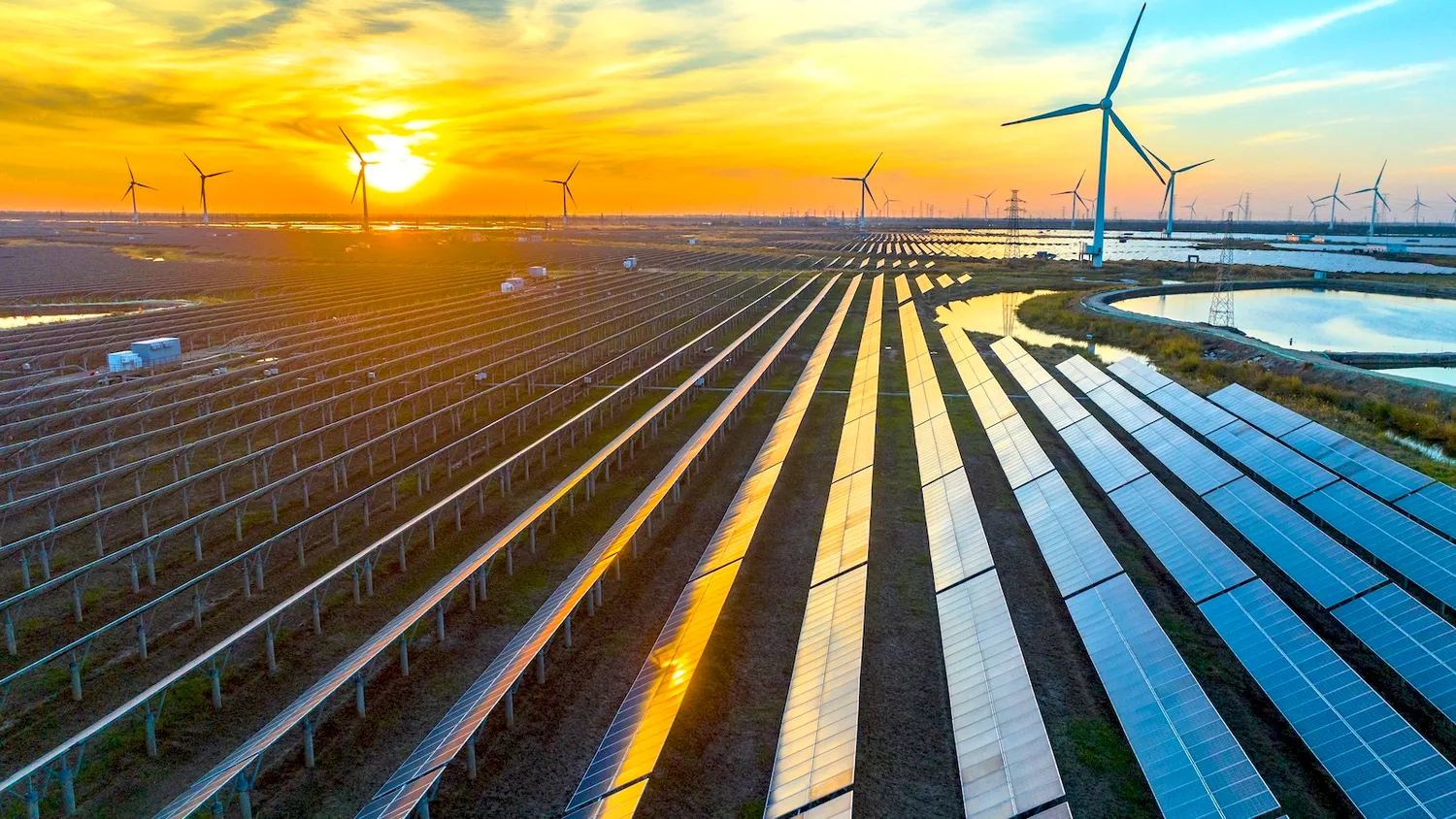
High reliability is the lifeline of AIDC energy storage. AIDC supports the core productivity of artificial intelligence enterprises and requires power availability levels exceeding 99.9%; even a single power interruption can result in substantial economic losses. This necessitates energy storage systems with millisecond-level response capabilities to smooth load fluctuations in real time, as well as a three-tier protection architecture spanning cell, module, and system levels to withstand grid faults, extreme weather, and other external risks. However, the response speed and protection mechanisms of traditional energy storage systems are increasingly insufficient to meet the stringent reliability requirements of AIDC.
Cost control is critical to the commercialization of AIDC energy storage. AIDC is a capital-intensive industry, and both the upfront investment and operating costs of energy storage systems have a direct impact on overall project economics. At present, the costs of battery cells and system integration remain relatively high, while AIDC demands large-scale and long-duration energy storage deployments. Reducing total lifecycle costs without compromising performance has therefore become a key constraint on industry development. In addition, the energy conversion efficiency of integrated wind–solar–storage systems directly affects the economic viability of green power. If the cost of renewable electricity cannot be reduced to levels comparable with conventional energy sources, the commercialization of green power supply for AIDC will be significantly hindered.
Clear Directions for Technological Iteration
In response to the specific demands of AI data centers (AIDC), the technological evolution path of the energy storage industry is becoming increasingly clear. Focusing on four core directions—long-duration energy storage, high-voltage architectures, multi-technology integration, and intelligent dispatch—the industry is accelerating innovation and breakthroughs.
Long-duration energy storage is a key enabler for addressing the challenge of “computing power waiting for electricity” and for advancing the green transition of AIDC. To resolve the structural mismatch between rapid computing power upgrades and long power infrastructure construction cycles, leading companies are exploring the deployment of long-duration energy storage systems at the source side. Taking Hithium as an example, its AIDC solution tightly couples energy storage with wind and solar generation, reducing power infrastructure construction cycles from the traditional 5–10 years to just 1–2 years. When the share of green electricity in AIDC exceeds 80%, long-duration energy storage systems with durations of over eight hours not only significantly reduce the levelized cost of electricity, but also play a critical role in enhancing power system resilience and enabling microgrid black-start capabilities.
High-voltage DC power architectures are emerging as a mainstream trend. NVIDIA’s 800 V DC power supply solution has become an important technical benchmark for AIDC energy storage. Products such as central energy routers can directly convert medium-voltage grid power into 800 V DC, simplifying the power supply chain and reducing energy losses. At the same time, they are compatible with 800 V electric vehicle charging systems, enabling “multi-purpose” utilization of energy storage assets. Looking ahead, high-voltage architectures are expected to extend to even higher voltage levels to accommodate the continuously rising power density requirements of AIDC.
Lithium-ion and sodium-ion technologies are evolving toward complementary integration. Hithium is deploying a dual-technology strategy combining lithium-ion and sodium-ion batteries to meet the diverse needs of different AIDC scenarios. Sodium-ion batteries, with advantages in high power capability and wide operating temperature ranges, are well suited for rack-level power support in AIDC, addressing millisecond-level load fluctuations. Lithium-ion batteries, by contrast, offer higher energy density and better economics, making them more suitable for long-duration energy storage on the grid side or campus level, where they can be deeply integrated with wind and solar generation. Industry experts widely believe that this complementary technology integration will become a key development direction for future AIDC energy storage.
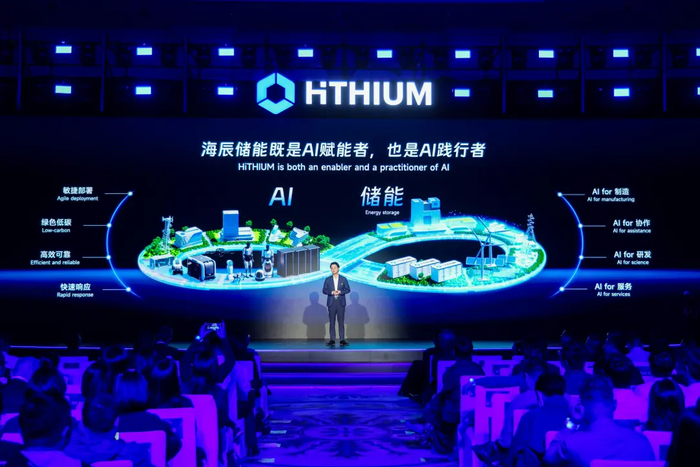
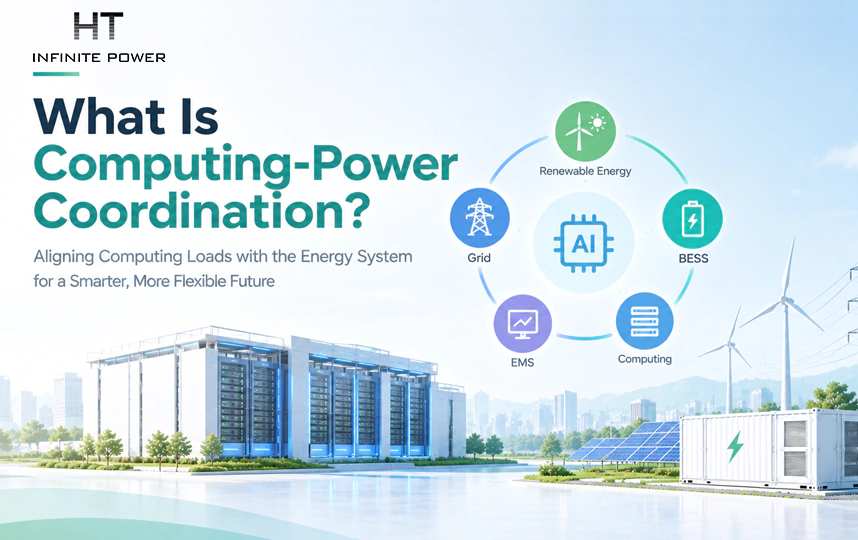
Intelligent dispatch and digital management are emerging as core competitive advantages. With the advancement of information technologies, energy utilization is entering a digital era, requiring AIDC energy storage systems to integrate with big data and artificial intelligence for intelligent scheduling. By continuously monitoring and analyzing AIDC load data, energy storage systems can anticipate load variations and proactively adjust charging and discharging strategies—storing energy during low-price periods and discharging during peak hours to maximize economic returns. Meanwhile, digital management platforms can monitor battery health in real time, reduce failure risks through early-warning mechanisms, and enhance overall system reliability and service life.
From a global perspective, the integration of AIDC and energy storage has become an irreversible trend. At the intersection of the Fourth Industrial Revolution and the Third Energy Revolution, only by closely aligning with evolving AIDC demands and overcoming technological bottlenecks can the energy storage industry seize the initiative in this transformation and drive the coordinated development of artificial intelligence and renewable energy industries.
What Is MVDC (Medium-Voltage DC) and Where Is It Used?
What Is AIDC Energy Storage?