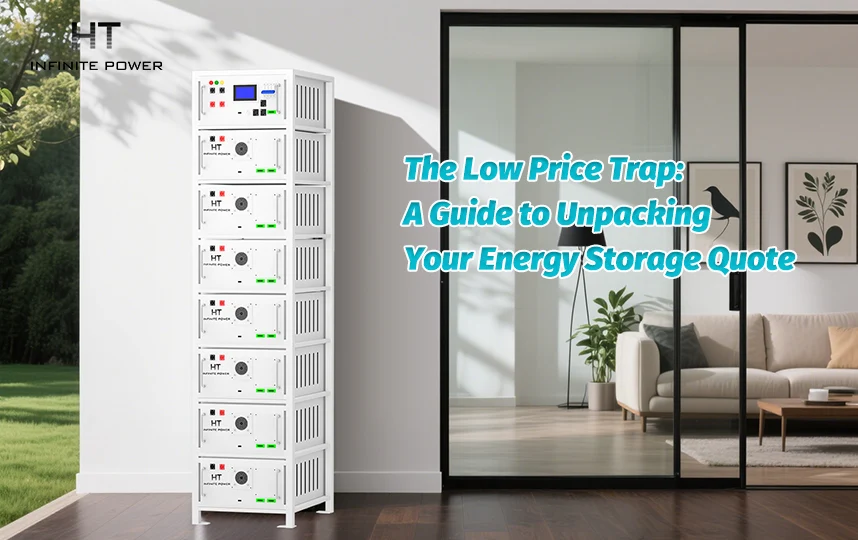
The Low Price Trap: A Guide to Unpacking Your Energy Storage Quote
2025-09-05
Opening line (hook): Why does a quote that seems impossibly cheap so often end in frustration, surprise invoices, or early system failure? This guide pulls back the curtain on what “cheap” commonly hides in the energy-storage market — from downgraded cells to omitted services — and gives you a practical checklist to spot traps and buy with confidence.
Opening Question & Promise
Question: “Why are some energy storage quotes unbelievably low?”
Promise: Read on and you’ll learn the five core truths that explain most suspiciously low prices, how to verify or debunk a quote in practical steps, and how to compare offers using total cost of ownership (TCO) — not just sticker price. This isn’t fear-mongering; it’s market literacy.
Promise: Read on and you’ll learn the five core truths that explain most suspiciously low prices, how to verify or debunk a quote in practical steps, and how to compare offers using total cost of ownership (TCO) — not just sticker price. This isn’t fear-mongering; it’s market literacy.
Why This Topic Matters to Buyers Today
The global energy storage market is booming — residential, commercial, and utility-scale projects are multiplying. Buyers face a crowded supplier field, aggressive pricing, and inconsistent standards across regions. When the difference between a credible offer and a risky one can be tens of thousands of dollars over a system’s lifetime, a superficial focus on the upfront number is a costly mistake. The smart question isn’t “How cheap?” but “How much value per year will this actually deliver?”

Core Revelation — The Five Truths Behind Low Prices
Below are the five most common realities hiding behind low quotes. Each truth includes how suppliers implement cost reductions, what that means for performance and safety, and what to demand instead.
Truth #1: Low-Quality or Second-Hand Cells
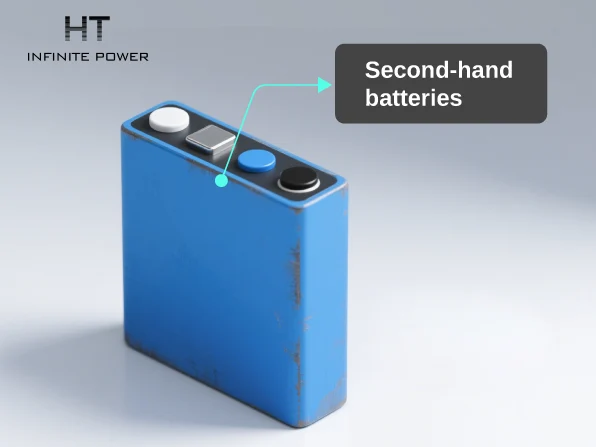
Many low bids start with the cell pack — the heart of any battery system. Cells account for a large share of material cost; swapping A-grade new cells for B-grade, C-grade, or second-life cells instantly cuts price. But you trade predictable performance for uncertainty.
Cell grading explained: A, B, C
Cell vendors grade cells by visual quality, measured capacity, internal resistance, and cycle life. A-grade cells meet spec tolerances, show minimal variance, and deliver expected cycle life. B/C grades exhibit higher variance, slightly lower capacity, and quicker degradation. Industry writeups and vendor guides show clear performance gaps between grades; relying on B-grade cells for a long-lived stationary system is a calculated risk.
Why second-life cells are risky (and when they’re acceptable)
Second-life (refurbished EV) cells can be a sustainable, lower-cost option if they’re thoroughly tested, re-matched, re-configured, and paired with a BMS engineered for their characteristics. But many low bids simply re-use modules with minimal requalification. Risks: unpredictable remaining capacity, faster capacity fade, cell imbalance, and complex safety profiles. Recent research emphasizes both the promise and technical hurdles of second-life reuse — it’s not an off-the-shelf shortcut.
Truth #2: Inflated Capacity and Power Ratings
Another common tactic: advertise a high kWh or kW number that sounds impressive while excluding qualifiers. Two main forms: (1) quoting nominal capacity without usable depth-of-discharge (DoD) limits; (2) quoting peak inverter power without clarifying continuous power or duration. Both inflate perceived value.
How suppliers 'massage' specs — what to look for
Practical checks: ask for usable kWh at a specified DoD (e.g., 80% DoD), not nominal cell energy; request continuous kW output and duration (e.g., 5 kW continuous for 2 hours), not just short bursts; verify round-trip efficiency (%). Insist suppliers provide datasheets and independent test reports (UN/IEC/UL standards where applicable). A manufacturer that resists sharing these specifics is a red flag.
Truth #3: Cut Corners on BMS and Passive Cooling
The BMS and thermal strategy are where many low-cost designs save money — and where savings bite back in performance and safety. A minimalist BMS or reliance on poor cooling strategies reduces initial cost but increases risk.
BMS functions that matter (and the cheap shortcuts you’ll spot)
A proper BMS does at least: cell voltage & temperature monitoring, active balancing, over/under voltage protection, charge/discharge current management, state-of-charge (SoC) estimation, fault logging, and communication (for diagnostics). Cheap systems might omit cell-level monitoring, use only passive balancing, or provide no remote telemetry. Those shortcuts accelerate imbalance, hide early failure signs, and complicate warranty claims. Industry primers list these core functions and why they’re essential.
Thermal management — passive vs active cooling
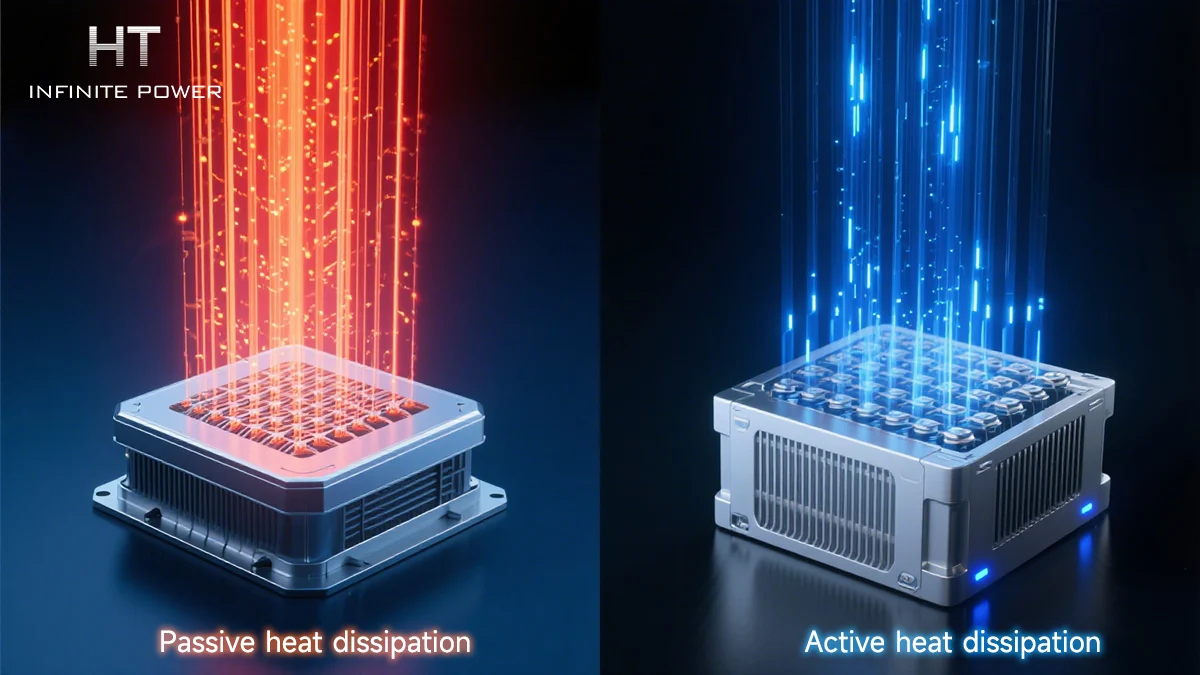
Batteries hate heat. Passive cooling (air gaps, heat sinks) may suffice for small packs in mild climates, but many low-cost systems skimp on active solutions (forced air, liquid cooling, conduction plates). That leads to hotspots, inconsistent aging between cells, and elevated thermal-runaway risk in abuse scenarios. Peer-reviewed reviews of thermal management underscore that investing in proper TMS (thermal management systems) pays off in longevity and safety.
Truth #4: Hidden Installation & Maintenance Costs
Some quotes intentionally omit key services: crane or scaffold for rooftop installs, shipping hazardous materials, commissioning, site upgrades, grid-interconnection fees, battery disposal or recycling, and long-term monitoring subscriptions. These “extras” can transform a cheap quote into a costly experience.
Truth #5: Weak After-Sales and Warranty Terms
Price competition often comes with minimal warranty coverage or opaque claim processes. A low quote may be paired with: short warranty duration, high pro-rata replacement costs, exclusions for environmental conditions, or burdensome claim documentation. Suppliers that invest in field service networks, remote diagnostics, spare modules, and clear SLAs are worth the premium.

How to Evaluate a Quote Like a Pro (step-by-step checklist)
Turn instincts into a repeatable process. Below is a step-by-step checklist to evaluate any quote before you sign. This checklist is meant to be used with the five truths above in mind.
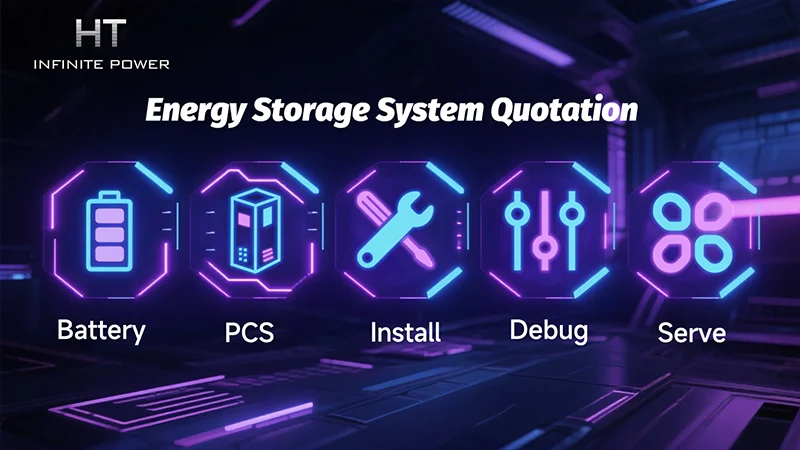
Break down the quote: what each line should mean
1. Cell cost & spec — Itemize cell supplier, grade (A/B/C), cell model, nominal & usable kWh, voltage, and rated cycle life (e.g., 6,000 cycles @ 80% DoD).
2. Battery pack assembly — enclosure IP rating, thermal system type, BMS vendor and functions.
3. Inverter / PCS — continuous vs peak power, efficiency, certifications.
4. Installation — site prep, mounting, wiring, commissioning test logs.
5. Soft costs — permits, grid interconnection, transport.
6. Service & warranty — SLA response times, replacement policies, software updates. If any line is missing, ask for details.
2. Battery pack assembly — enclosure IP rating, thermal system type, BMS vendor and functions.
3. Inverter / PCS — continuous vs peak power, efficiency, certifications.
4. Installation — site prep, mounting, wiring, commissioning test logs.
5. Soft costs — permits, grid interconnection, transport.
6. Service & warranty — SLA response times, replacement policies, software updates. If any line is missing, ask for details.
Quick technical checks you can do (no lab required)
- Ask for datasheets and independent test reports. Legit suppliers will provide UL/IEC test references and third-party cycle charts.
- Request an expected degradation curve (e.g., % capacity after 5 years, 10 years at specified DoD).
- Compare round-trip efficiency (typical lithium systems: 85–95%).
- Ask for fault logs and rem
- Request an expected degradation curve (e.g., % capacity after 5 years, 10 years at specified DoD).
- Compare round-trip efficiency (typical lithium systems: 85–95%).
- Ask for fault logs and rem
Compare using Total Cost of Ownership (TCO)
Calculate TCO: TCO = upfront cost + installation + expected maintenance + replacement costs — (projected energy savings) over the useful life. Use conservative assumptions for degradation and utility price escalation. A higher upfront cost can yield lower TCO — and that’s the metric that matters.
Case Studies: Real examples where low price backfired
Case A — Short-lived pack (residential): A homeowner selected the cheapest local bid. Two years in, several modules dropped to half capacity; supplier disputed warranty due to “improper use.” Final outcome: homeowner paid for module replacement and temporary generator hire during downtime. Lesson: check cell grade and warranty inclusions.
Case B — Missing commissioning (commercial): A small commercial site accepted a low bid which excluded commissioning. Undetected wiring mistakes caused reduced system output and repeated inverter trips. After months of troubleshooting, contractor charged for remote visits that weren’t estimated. Lesson: ensure commissioning and test logs are included. (These case types mirror widely reported industry patterns; for safety incident context see fire service guidance and incident reviews.)
Case B — Missing commissioning (commercial): A small commercial site accepted a low bid which excluded commissioning. Undetected wiring mistakes caused reduced system output and repeated inverter trips. After months of troubleshooting, contractor charged for remote visits that weren’t estimated. Lesson: ensure commissioning and test logs are included. (These case types mirror widely reported industry patterns; for safety incident context see fire service guidance and incident reviews.)
How reputable suppliers prove their value
Credible suppliers separate themselves by documentation and process: they provide full BOMs (bill of materials), third-party test reports, site assessment reports, commissioning logs, and clear SLAs. They also do customer onboarding (safety briefing, system monitoring training) and publish case studies. These are signs the supplier invests in long-term performance rather than short-term volume.
Practical tips to avoid the low price trap (actionable)
1. Insist on A-grade or explicitly qualified second-life cells; get traceability for cell batches. Evlithium
2. Request usable kWh, continuous kW, and expected degradation curve.
3. Confirm BMS features and thermal management design. Ask for architecture diagrams and fault scenarios. SynopsysSci Journals
4. Require itemized quotes that include installation and permits.
5. Check after-sales capacity: spare parts policy, technician network, remote monitoring.
6. Use TCO analysis with conservative assumptions (e.g., 2–3% annual capacity fade vs optimistic vendor numbers).
7. Ask for references and visit working systems if possible — screenshots and serial logs are good proxies.
2. Request usable kWh, continuous kW, and expected degradation curve.
3. Confirm BMS features and thermal management design. Ask for architecture diagrams and fault scenarios. SynopsysSci Journals
4. Require itemized quotes that include installation and permits.
5. Check after-sales capacity: spare parts policy, technician network, remote monitoring.
6. Use TCO analysis with conservative assumptions (e.g., 2–3% annual capacity fade vs optimistic vendor numbers).
7. Ask for references and visit working systems if possible — screenshots and serial logs are good proxies.
Conclusion — Invest for value, not for sticker shock
Cheap quotes tempt the wallet and can fool the eye. But in energy storage, the true cost is paid over years through lost capacity, safety incidents, and surprise bills. The five truths above are not horror stories — they’re patterns. Learn to read a quote like a technician and a buyer: scrutinize cells, specs, BMS, thermal design, and the service contract. Insist on transparency, demand data, and evaluate by TCO. That’s how you turn a quote into a sound investment.
FAQ (5 concise Q&A)
Q1: Are all low-priced quotes bad?
A1: Not always. A low price can reflect regional cost advantages or promotional discounts. But unusually low quotes that lack documentation or exclude key services are risky. Use the checklist above.
Q2: How can I verify cell grade?
A2: Ask for manufacturer batch numbers, independent test reports, and traceability paperwork; reputable suppliers supply these. Q3: What’s an acceptable warranty?
A1: Not always. A low price can reflect regional cost advantages or promotional discounts. But unusually low quotes that lack documentation or exclude key services are risky. Use the checklist above.
Q2: How can I verify cell grade?
A2: Ask for manufacturer batch numbers, independent test reports, and traceability paperwork; reputable suppliers supply these. Q3: What’s an acceptable warranty?
Q3: What is an acceptable warranty?
A3: Look for multi-year coverage (5–10 years) with clear pro-rata terms, defined performance thresholds, and a responsive service SLA.
Q4: Can second-life batteries be a good bargain?
A4: Yes — when they are requalified and paired with a BMS engineered for reused modules. Unqualified reuse is the risk.
Q5: Who pays for installation extras and grid interconnection?
A5: The quote should state this. If not, presume vendor will charge separately — insist on a fully itemized scope before contracting.
A3: Look for multi-year coverage (5–10 years) with clear pro-rata terms, defined performance thresholds, and a responsive service SLA.
Q4: Can second-life batteries be a good bargain?
A4: Yes — when they are requalified and paired with a BMS engineered for reused modules. Unqualified reuse is the risk.
Q5: Who pays for installation extras and grid interconnection?
A5: The quote should state this. If not, presume vendor will charge separately — insist on a fully itemized scope before contracting.
IP Ratings, Cooling Methods, and Outdoor Cabinet Selection Guide for Battery Energy Storage Systems
How to Calculate Your Home Energy Storage ROI