Liquid Cooling: $100B Market for Data Centers & Storage
2025-11-20

Currently, high-performance data centers—core infrastructure for AI computing power—and energy storage systems—key pillars of the new power system—face a common critical challenge: heat dissipation. Air cooling technology has neared its physical limits, while liquid cooling, with its high efficiency, energy-saving, and precise temperature control capabilities, is evolving from an option to a necessity, ushering in a historic opportunity.
Energy Storage Liquid Cooling: Large Cells Drive High-Power Temperature Control Upgrades
The iteration of liquid cooling for energy storage is directly driven by advancements in battery cells and systems. Since 2023, propelled by 314Ah cells and 5MWh systems, mainstream temperature control solutions have shifted from air cooling to liquid cooling. At that time, leading industry 5MWh systems adopted liquid cooling units with a cooling capacity of approximately 45kW, while most similar solutions used 60kW units.
Since the start of this year, as large-capacity cells above 500Ah enter mass production, energy storage systems above 6MWh have emerged as new market focal points. Industry analysis indicates that in conventional 2-hour charge-discharge scenarios, the concentrated heat release from shorter discharge times has pushed the cooling demand of supporting temperature control systems from 45kW-60kW to 65kW-80kW. For example, a 6.25MWh system based on 587Ah cells typically requires a 75kW liquid cooling unit for the 2-hour configuration, while the 4-hour version—with gentler heat release—only needs around 35kW.
Notably, current specifications for large battery cells remain unstandardized. The 587Ah cell has gained relatively high recognition, but the future market structure remains uncertain. Meanwhile, innovations in next-generation system architectures such as modularization have raised higher requirements for the compatibility and flexibility of temperature control solutions. Industry experts point out that if cell specifications continue to diversify, temperature control enterprises will have to develop multiple solutions for different models, significantly increasing product development costs.
Technology Race: High Power, Compact Design, and Intelligence Take Center Stage
In response to clear market demand, mainstream temperature control enterprises have launched a technology race. For 6-7MWh large-scale energy storage systems, the cooling capacity of new-generation liquid cooling units has generally jumped to the 80kW-90kW range, with distinct development trends:

- High Power and Compactness: The latest solutions achieve 90kW high cooling capacity while striving for ultra-thin designs to maximize space savings inside containers.
- Energy Efficiency and Reliability: Integration of free cooling technologies (e.g., XFreeCooling) significantly improves lifecycle energy efficiency. Integrated architectures and intelligent control logic aim to address pain points such as extreme environment adaptability and noise control.
- Technological Diversification: Some innovative solutions incorporate cutting-edge technologies like air-bearing centrifugal compression, with compressors reaching extremely high rotational speeds, representing different paths of technological exploration.
Data Center Liquid Cooling: An Inevitable Choice for High-Density Computing Power
Compared to energy storage, the demand for liquid cooling in data centers is more urgent. As the power density of AI chips surges, single-rack power has jumped from the traditional 5-10kW to 100kW or higher, making traditional air cooling inadequate. Meanwhile, policies mandate data center PUE (Power Usage Effectiveness) to be below 1.5. Thanks to its superior heat dissipation efficiency—with a thermal conductivity 15-25 times that of air—liquid cooling can optimize PUE to around 1.15, reducing overall energy consumption by approximately 30% compared to air cooling.
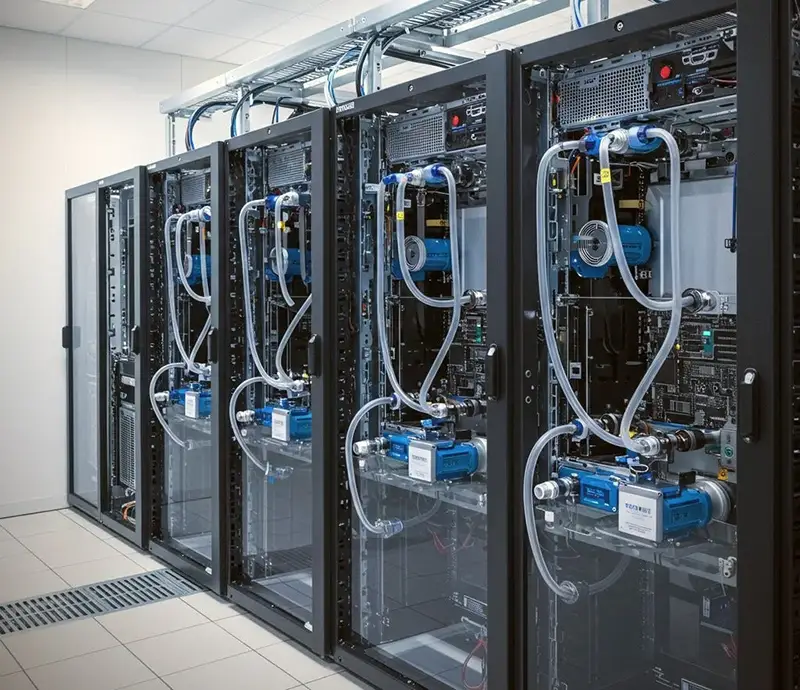
According to research institution data, China's data center liquid cooling market reached about 16 billion yuan in 2024. The penetration rate of liquid cooling is expected to rise to 30%-40% in the next 3-5 years, with the market size projected to exceed 100 billion yuan by 2030. Currently, cold plate liquid cooling accounts for over 90% of the market share, while immersion and spray cooling technologies are also advancing. Temperature control enterprises offer a wide product range, from tens-of-kilowatt rack-mounted CDUs (Cooling Distribution Units) to megawatt-scale containerized CDUs. Internationally leading enterprises have even launched scalable solutions above 10MW.
Summary
Driven by the dual engines of AI computing power and large-scale energy storage, liquid cooling technology has transcended its role as a mere heat dissipation tool to become a foundational technology supporting global digitalization and energy transition. Its technical routes are rapidly evolving toward higher cooling capacity and energy efficiency, unfolding a blueprint for a 100-billion-yuan market.
AGC vs. AVC Explained: Differences, Control Mechanisms, and the Role of Energy Storage
Fast-Ramp Battery Packs: Design for High C-Rate Industrial Use