What Is Depth of Discharge (DOD) and How Does It Affect Battery Life?
2025-07-25
1.Introduction: Why Depth of Discharge Is Crucial in Modern Energy Storage
Imagine you own a coffee shop that runs on solar panels by day and a battery bank by night. If you drain most of your battery every evening, you’ll get lots of run-time—but you’ll also wear out the battery faster. That simple trade-off captures the essence of Depth of Discharge (DOD): a metric that tells you how much of a battery’s capacity you’ve used, and signals how much stress you’re putting on its chemistry.
In today’s energy landscape—where home solar, electric fleets, and large-scale industrial storage all rely on batteries—understanding DOD isn’t optional. It’s the key to maximizing performance, extending lifespan, avoiding safety risks, and getting the best return on your investment.
In this guide, we’ll explore:
In today’s energy landscape—where home solar, electric fleets, and large-scale industrial storage all rely on batteries—understanding DOD isn’t optional. It’s the key to maximizing performance, extending lifespan, avoiding safety risks, and getting the best return on your investment.
In this guide, we’ll explore:
- What DOD really means and how it’s measured
- Why mixing up DOD and State of Charge can be costly
- How DOD affects different battery types, from lead-acid to lithium-ion and flow batteries
- Practical tips for residential and commercial systems
- Real-world case studies illustrating both good and bad DOD practices
- And a deep dive into optimizing DOD for safety, cycle life, and total cost of ownersh
2.What Does Depth of Discharge (DOD) Actually Mean?
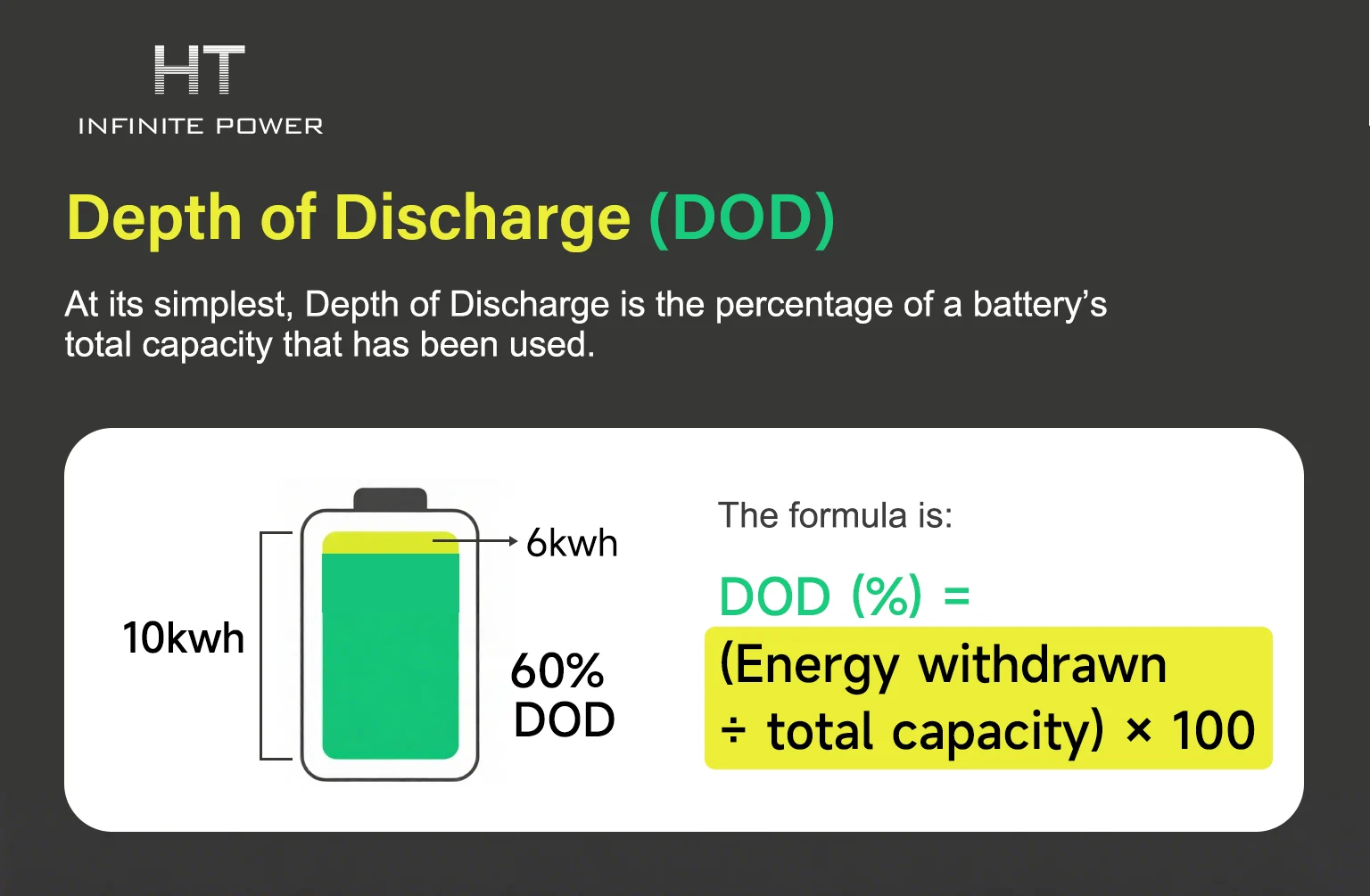
At its simplest, Depth of Discharge is the percentage of a battery’s total capacity that has been used. If you have a 10kWh battery and you draw 6kWh, you’ve reached a 60% DOD. The formula is:
DOD (%) = (Energy withdrawn ÷ Total capacity) × 100
Why is this more than just math? Because every time you discharge a battery, you’re applying mechanical and chemical stress. Picture jogging versus sprinting. A light jog might be fine every day, but daily sprints wear you out quickly. Batteries behave much the same way: shallow discharges (low DOD) are easy on them; deep discharges (high DOD) accelerate wear and tear.
2.1 How DOD Is Measured in Practice
Modern battery systems—whether a home energy storage unit or a megawatt-scale commercial container—come with a Battery Management System (BMS). The BMS tracks voltage, current, and temperature in real time, and calculates DOD by integrating the current draw over time. Operators see DOD displayed on dashboards, power management software, or even mobile apps, enabling informed decision-making.
2.2 Everyday Examples to Grasp DOD

- Smartphone: When your phone drops from 100% to 20% charge, it has experienced an 80% DOD.
- Home Solar + Storage: You charge a 13.5 kWh home battery fully during the day and use 8 kWh overnight—that’s about 59% DOD.
- Electric Vehicle: Driving an EV with a 75 kWh pack from 100% to 25% uses 56kWh, or 75% DOD.
These simple examples highlight how DOD is a universal concept across scales.
3.How Does Depth of Discharge Work in Real Energy Storage Systems?
3.1 Residential Battery Systems
Home energy storage systems, like the Tesla Powerwall or LG Chem RESU, are typically set to a maximum DOD of 80%. This balance allows homeowners to use most of their stored energy while preserving enough buffer to extend battery life. Most manufacturers design the BMS to prevent deeper discharges, which could void warranties or trigger protective shutdowns.
3.2 Commercial & Industrial Storage
Warehouses, data centers, and manufacturing facilities often cap DOD at 50% or even lower. Why? Because they cycle their batteries daily, sometimes multiple times, to shave peak demand charges or participate in frequency regulation markets. Operating at a shallow DOD keeps the batteries healthy for thousands of cycles—translating into predictable performance and fewer replacements over time.
3.3 Utility-Scale Applications
Grid-scale projects—like renewable integration or grid-forming microgrids—may cycle at just 10–20% DOD. These systems serve as giant buffers for renewable intermittency rather than primary energy sources. Low DOD preserves battery integrity for decades, which is vital when dealing with multi-million-dollar installations.
4.State of Charge (SOC) vs. Depth of Discharge (DOD)
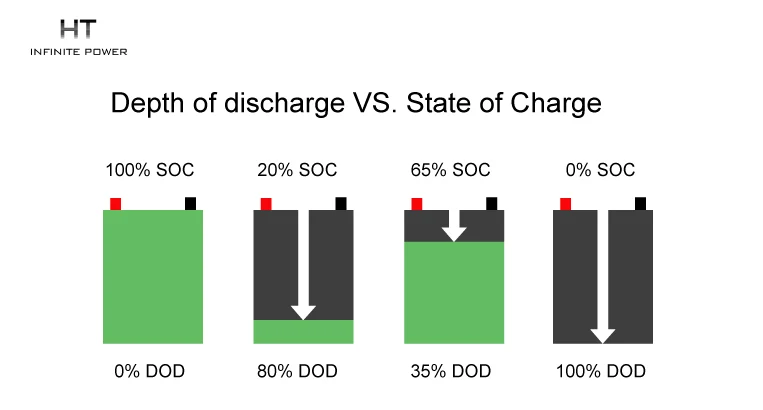
While DOD measures energy used, State of Charge (SOC) measures energy remaining. They’re two sides of the same coin:
SOC (%) = 100% – DOD (%)
A battery at 30% SOC has experienced a 70% DOD. Mixing these terms up can lead to operational errors:
4.1 Why Mixing Up SOC and DOD Leads to Costly Mistakes
Imagine planning maintenance when SOC dips below 20%, not realizing this corresponds to an 80% DOD. You might schedule service too late, causing over-discharge damage. In industrial settings, this confusion can mean surprise downtime, emergency replacements, and lost revenue.
5.Why Depth of Discharge Matters for Battery Health, Safety, and ROI
5.1 Over-Discharge Phenomena and Safety Risks
Over-discharging batteries can trigger:
- Thermal Runaway: In lithium‑ion cells, extreme DOD can cause internal shorts and thermal events.
- Sulfation: Lead‑acid batteries, when drained too deeply, form lead sulfate crystals that permanently reduce capacity.
These safety hazards underscore why DOD management is a core design criterion.
5.2 Financial Impact: Cycle Life and Replacement Costs
Battery lifespans are expressed in cycles at specified DOD levels:
- 50% DOD → 5,000 cycles
- 80% DOD → 3,000 cycles
- 100% DOD → 1,000 cycles

A 500kWh commercial battery bank at $200/kWh costs $100,000. Operating at 50% DOD might last 5,000 cycles (≈14 years at daily cycling), whereas at 80% DOD it lasts only 3,000 cycles (≈8 years). That difference of 6 years and 2,000 cycles translates into an extra $40,000–$60,000 in replacement costs, not counting downtime or labor.
6.DOD’s Impact on Different Battery Chemistries
6.1 Lead-Acid Batteries
Classic lead-acid is cheap but sensitive to DOD. Best practice keeps DOD ≤50%. Exceeding this regularly slashes life expectancy from 1,200 cycles to 500 or fewer.

6.2 Lithium-Ion Batteries
Lithium chemistries (NMC, LFP) handle deeper DOD—up to 90% safely. However, running every cycle at 90% DOD still accelerates calendar and cycle aging. Most vendors recommend an 80% DOD cap for balanced performance and longevity.
6.3 Flow Batteries
Unlike solid-state batteries, flow batteries (e.g., vanadium redox) tolerate 100% DOD without capacity loss. Their modular nature makes them ideal for heavy-use scenarios, such as daily arbitrage or grid services—but they come with higher upfront costs and lower energy density.
7.Manufacturer Guidelines & Warranty Considerations
7.1 Typical DOD Limits and Cycle Ratings
Manufacturers publish DOD vs. cycle‑life curves in datasheets. For example:
- Company A’s LFP pack: 80% DOD → 4,000 cycles
- Company B’s NMC pack: 90% DOD → 3,000 cycles
7.2 Warranty Clauses You Must Know
Warranties often specify maximum allowable DOD for coverage. Exceeding specified DOD voids warranties—so read the fine print. Some vendors even track cumulative deep-discharge events via BMS telemetry to enforce these terms.
8.Depth of Discharge in Residential Solar + Storage
8.1 Setting DOD to Balance Savings and Longevity
Solar homeowners typically program their systems for 70–80% DOD daily. This ensures enough buffer to handle cloudy days without risking deep cycling that shortens battery life.
8.2 Real-World Home System Example
A 13.5kWh home battery might discharge 8 kWh each night (≈60% DOD), powering essential loads and charging back up by noon via solar. This cycle profile has proven to sustain 3,000+ cycles over 7–8 years—matching typical home battery warranties.
9.Depth of Discharge in Commercial & Industrial Storage
9.1 Peak Shaving with Controlled DOD
Factories use batteries to shave demand peaks. By discharging just 40–50% each day at critical hours, they avoid costly demand charges while preserving battery health.
9.2 Demand Charge Management
A 500kW/2MWh system set at 50% DOD can fire up 500kW for 2hours—enough to slice off afternoon peaks without stressing the battery unduly.
10.Relationship Between DOD, Cycle Life & Round-Trip Efficiency
10.1 How Deep Cycles Affect Usable kWh Over Time
Every cycle has round-trip losses (85–95% efficiency). At deep DOD, internal resistance increases, reducing efficiency further. This compounds over thousands of cycles, making shallow cycling economically attractive despite lower immediate utility.
11.Common Misconceptions About Depth of Discharge
11.1 “Full-Depth Cycling Is Always Better” Myth
Some think squeezing every last kWh each cycle maximizes value. In reality, this wreaks havoc on cycle life and total delivered energy over a battery’s life.

11.2 DOD vs. Remaining Capacity Confusion
Mixing DOD with capacity percentage leads to planning errors. Always base decisions—maintenance schedules, replacement forecasts—on DOD metrics.
12.How to Optimize Depth of Discharge in Your System

12.1 Smart Battery Management Systems (BMS)
Advanced BMS algorithms predict load profiles and dynamically adjust DOD limits to balance performance with longevity.
12.2 Operational Strategies for Businesses
- Load shifting: Run non-critical loads at off-peak times, preserving battery for peak shaving.
- Scheduled cycling: Use predictive analytics to only cycle deeply when grid prices justify it.
13.Real-World Examples of DOD Mismanagement
13.1 Case Study: Factory with Early Battery Failures
A beverage bottling plant overshot 80% DOD daily to save on grid bills, only to replace their entire 1 MWh bank after 2 years—3,000% over budget cycle-life costs.
13.2 Data-Driven Insights on Lifecycle Costs
Analysis of 50 commercial installations showed that limiting DOD to 60% extended life by 30%, saving $1.2 million across fleet replacements.
14.DOD, System Sizing & Cost Planning
14.1 Oversizing for Lower DOD
Specifying a slightly larger battery bank lets you run shallower cycles, extending lifespan and smoothing cash-flow over longer intervals.
14.2 Budget Trade-Offs in kW vs. kWh Capacity
Investing in extra kWh capacity (battery modules) to allow lower DOD may yield higher ROI than oversizing inverter kW alone.
15.Conclusion: Why Paying Attention to DOD Protects Your Investment
Depth of Discharge isn’t just a technical footnote; it’s the pulse of any energy storage strategy. By understanding and managing DOD—whether in your home, your warehouse, or on the grid scale—you safeguard battery health, improve safety, optimize financial returns, and ensure reliable power when you need it most.
Frequently Asked Questions (FAQs)
Q1. What is considered a good Depth of Discharge (DOD) for daily battery use?
For most lithium-ion battery systems, keeping the Depth of Discharge (DOD) between 70% and 90% is considered optimal for daily use. This range gives you a good balance between usable energy and long-term battery health. Most industrial energy storage systems will allow you to configure this via software.
Q2. Why does a deeper DOD reduce battery lifespan?
The deeper a battery is discharged during each cycle, the more stress it places on its chemical structure. This accelerates capacity fade and shortens cycle life. For example, a battery cycled to 90% DOD may only last half as many cycles compared to shallow discharges of 50% DOD.
Q3. How does Depth of Discharge relate to battery degradation?
DOD measures how much energy you use from the battery in one cycle. Degradation refers to the battery’s permanent loss of capacity over time. While deeper DOD speeds up degradation, factors like temperature, charging speed, and calendar aging also contribute. That’s why both need to be considered in any energy storage system design.
Q4. Can adjusting DOD help reduce operating costs over time?
Yes. Many businesses fine-tune their DOD settings to extend battery life and reduce replacement costs. By using a moderate DOD, they can stretch out the lifespan of their storage system while still meeting most of their energy needs.
What Is Battery Swelling and What Causes It in Lithium-Ion Systems?
What is the Difference Between kW and kWh?