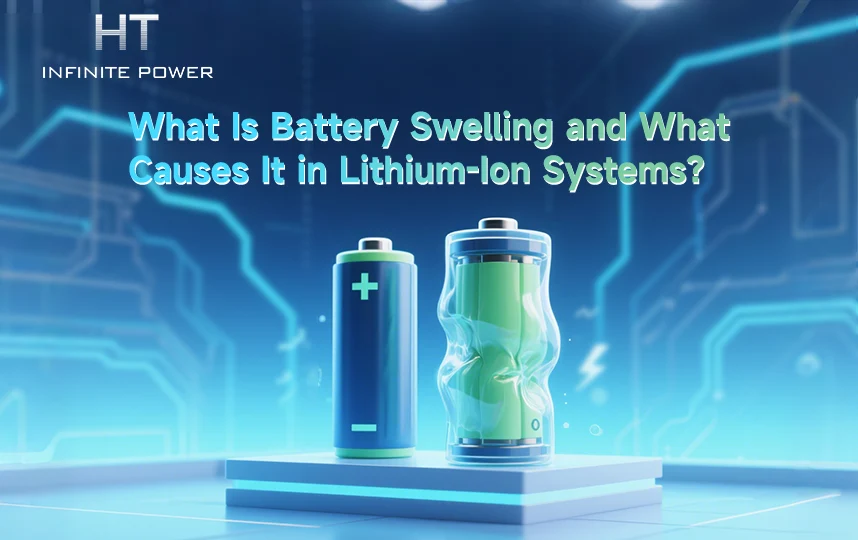
What Is Battery Swelling and What Causes It in Lithium-Ion Systems?
2025-07-30
1.Introduction: Why Battery Swelling Matters
Imagine plugging in your home energy storage module after a sunny day of solar charging, only to notice its case bulging at the seams. Or picture a commercial container of lithium-ion batteries on an industrial site, where a single swollen cell forces a shutdown for safety reasons. In both home and industrial settings, battery swelling signals trouble—reducing capacity, risking leaks or fires, and triggering costly downtime.
Whether you’re a homeowner seeking reliable backup power or an energy manager running a fleet of industrial storage containers, understanding what battery swelling is and why it happens is critical. In this guide, we’ll unpack the science behind swelling, its real-world impacts, and practical ways to detect and prevent it—helping you safeguard performance and extend the life of your lithium-ion systems.
2. What Is Battery Swelling?
Battery swelling refers to the physical expansion or “puffing” of a lithium-ion cell or module when gases form inside the sealed casing. These gases can accumulate in the cell’s pouch or cylinder, pushing outwards and causing the outer shell or module casing to bulge.
In severe cases, swollen cells can crack their seals, leak electrolyte, or even rupture—posing serious safety hazards. But even mild swelling reduces energy density and disrupts mechanical alignment in battery packs, leading to poor electrical connections and uneven aging across cells.
In severe cases, swollen cells can crack their seals, leak electrolyte, or even rupture—posing serious safety hazards. But even mild swelling reduces energy density and disrupts mechanical alignment in battery packs, leading to poor electrical connections and uneven aging across cells.
3. Core Causes of Swelling in Lithium-Ion Cells
Lithium-ion batteries are complex electrochemical devices. When certain stressors push the chemistry past safe limits, they generate gases that have nowhere to escape. Let’s explore the main triggers:
3.1 Overcharging and Excessive Voltage
Charging a cell beyond its recommended maximum voltage (e.g., >4.2 V for many Li-ion chemistries) forces extra lithium ions into the anode. This over‐intercalation damages the graphite structure and accelerates electrolyte decomposition, liberating gases such as CO₂ and CO.
- Home scenario: Leaving a residential battery at 100% SOC on hot days can slowly push voltage above safe thresholds.
- Industrial scenario: A malfunctioning PCS or charger without proper voltage cut-off may overcharge large racks of modules.
3.2 High-Temperature Stress
Elevated temperatures (above ~45 °C) increase reaction rates inside the cell. While a brief spike might be tolerable, sustained thermal abuse degrades electrolyte and electrode binders, producing gas and swelling.

Example: An inadequately cooled container in a warehouse during summer can see module temperatures climb, triggering gas formation and puffing.
3.3 Deep Discharge & High C-Rates
Discharging deeply (high Depth of Discharge) or at high currents (C-rates) stresses cell materials. Deep discharge can expose electrode surfaces to side reactions, while rapid discharge/charge cycles heat the cell, both promoting gas evolution.
- Residential: EV fast-charging at high C-rates overnight stresses cells compared to slow, daytime charging.
- Commercial: High-power peak shaving applications demand fast cycles that can drive swelling if not managed.
3.4 Electrolyte Decomposition & Gas Generation
Over time, even under normal use, electrolytes slowly decompose—especially when contaminated by moisture or degraded by high voltage. These side reactions generate gases like ethylene and methane, which accumulate in sealed cells.
- Mitigation tip: High-purity electrolyte formulation and moisture-controlled manufacturing reduce initial gas potential.
4. How Swelling Affects Battery Performance and Safety
Swelling isn’t just unsightly—it has concrete repercussions:
Reduced Capacity: Gases displace active material, lowering how much lithium can shuttle between electrodes.
Poor Heat Dissipation: Bulging cells disrupt designed thermal paths, leading to hot spots and uneven aging.
Mechanical Stress: Expansion can crack welds or crush separators, risking internal short circuits.
Safety Hazards: Leaking electrolyte is corrosive; worst case, thermal runaway can ignite fires.
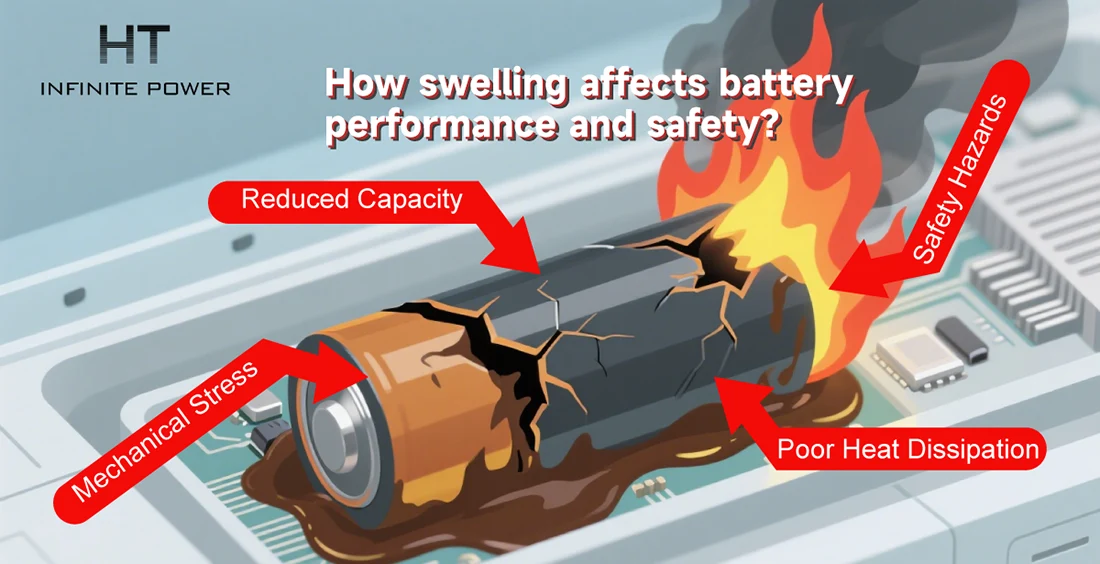
In both home battery modules and industrial energy storage containers, even slight swelling can trigger protective relays or BMS alarms—forcing system shutdown and costly service calls.
5. Detecting Early Signs of Swelling
Regular monitoring helps catch swelling before it becomes critical:
Visual Inspection: Look for gaps or bulges in pouch cells or endplate warping in prismatic modules.
Thickness Measurement: Calipers can quantify incremental pouch expansion.
Voltage/Impedance Drift: Swollen cells often show higher internal resistance and voltage sag under load.
BMS Alerts: Advanced systems flag abnormal temperature gradients or module height changes.

Implementing simple inspection routines—monthly for home systems and weekly for commercial racks—helps spot issues early.
6. Preventing and Managing Swelling in Storage Systems
6.1 Battery Management Systems (BMS)
A robust BMS is your first defense. It enforces:
Voltage cut-offs to prevent overcharge
Current limits to avoid excessive C-rates
Cell balancing to ensure uniform SOC across modules
Current limits to avoid excessive C-rates
Cell balancing to ensure uniform SOC across modules
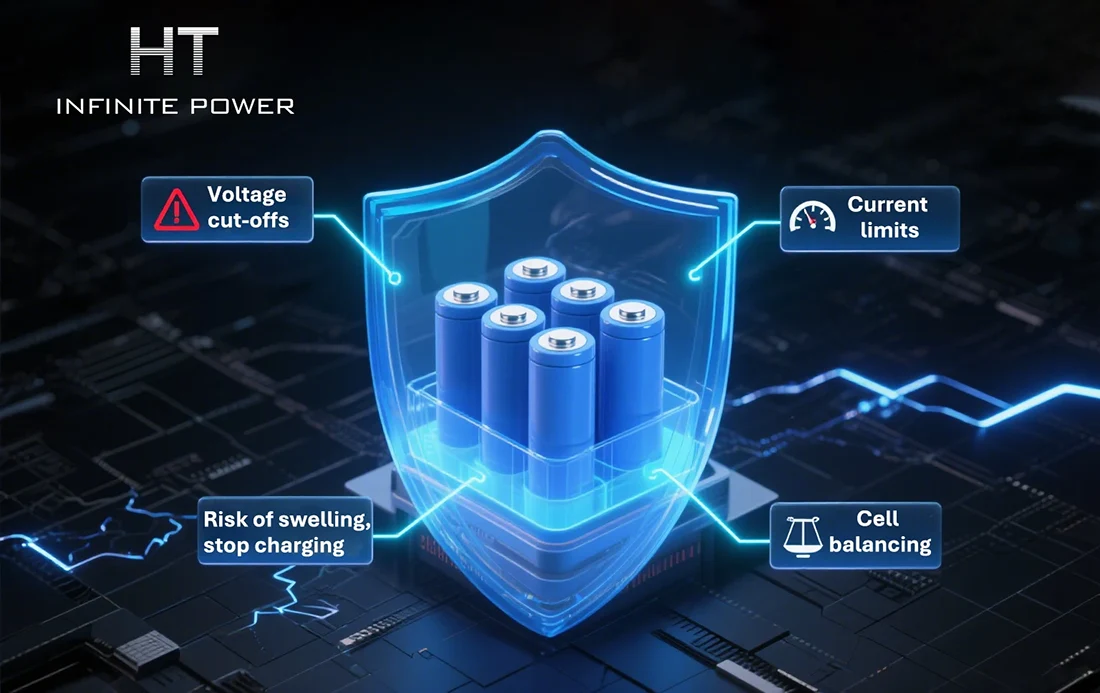
Well-tuned BMS algorithms stop charging when swelling risk is detected, preserving cell integrity.
6.2 Thermal Management Strategies
Active cooling (air or liquid) maintains module temperatures in the 15–35 °C sweet spot. For outdoor installations, consider shade, insulation, or climate-controlled enclosures to mitigate ambient heat.

6.3 Proper Charging Protocols
Avoid topping off to 100% SOC when not needed—set a practical max SOC (e.g., 90%) for daily cycling.
Use gentle charge currents for long idle periods—trickle charging is gentler on cells than high C-rate top-off.
Use gentle charge currents for long idle periods—trickle charging is gentler on cells than high C-rate top-off.
6.4 Routine Maintenance & Inspections
Clean contacts and ventilation paths to ensure proper thermal and electrical performance.
Record module dimensions over time to detect gradual puffing before it compromises full pack alignment.
Record module dimensions over time to detect gradual puffing before it compromises full pack alignment.
7. Real-World Scenarios: Home vs. Commercial Storage
Home Solar + Battery: A homeowner experienced battery puffing after installing modules in an unventilated garage. Solution: added an exhaust fan, reprogrammed BMS to cap SOC at 85%, and swelling ceased.
Industrial Container: A logistics center’s 1MWh container saw module bulges after repeated peak-shaving cycles at 2C. By limiting discharge C-rate and upgrading cooling, they halted further swelling and extended system life.
8. Conclusion: Keeping Your Batteries Healthy
Battery swelling is a silent threat—creeping up from overvoltage, heat, or aggressive cycling. Whether you’re powering your home or a high-demand industrial process, the key to longevity is understanding the causes, detecting early signs, and proactively managing your system with strong BMS, smart thermal control, and sensible operating practices.
With these measures in place, you can enjoy reliable, efficient energy storage without the worry of bulging modules or unexpected downtime.
9. Frequently Asked Questions (FAQs)
Q1. Can slight swelling ever be reversed?
Minor puffing from early gas formation sometimes stabilizes when you adjust charge protocols and cooling. However, permanent cell damage often remains—monitor capacity and plan for module replacement.
Q2. Does battery swelling only occur in pouch cells?
No—prismatic and cylindrical cells can swell too, though pouch cells are most prone due to their sealed, soft-pack design.
Q3. How often should I inspect my battery modules for swelling?
For home systems, a visual check every 1–2 months is sufficient. Commercial racks warrant weekly inspections as part of preventive maintenance.
Q4. Is gas release from swelling cells toxic?
Electrolyte gases can be harmful or flammable. Always inspect in a well-ventilated area, wear protective gear, and follow manufacturer safety guidance.
Q5. When should I replace a swollen battery module?
If swelling exceeds ~5 mm of pouch expansion or causes mechanical binding, plan for replacement immediately to avoid safety or performance issues.
What Is Cell-Level Monitoring and Why It Improves Storage Safety?
What Is Depth of Discharge (DOD) and How Does It Affect Battery Life?