What is a flow battery?
2024-12-25
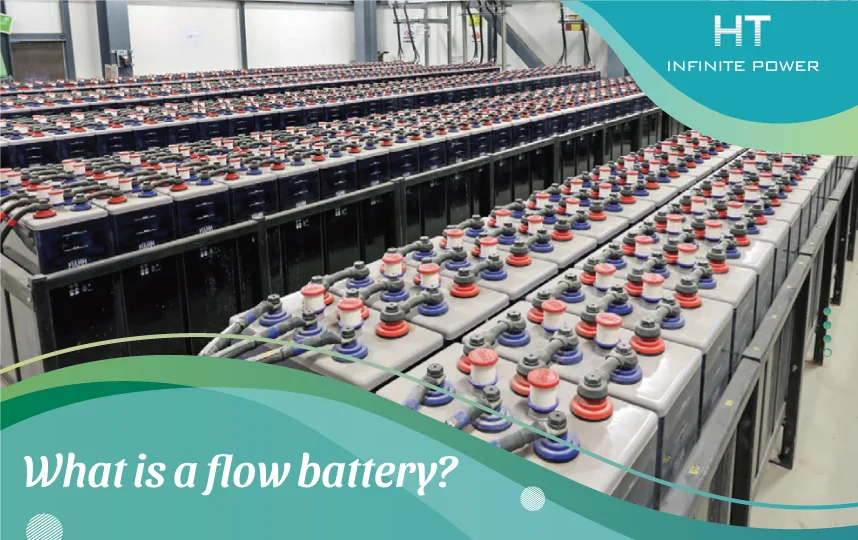
Flow battery is an electrochemical energy storage technology proposed by Thaller in 1974. It is a new type of battery.
Flow battery consists of a battery stack unit, electrolyte, electrolyte storage and supply unit, and management control unit. It is a high-performance battery that separates the positive and negative electrolytes and circulates them separately. It has the characteristics of high capacity, wide application field (environment), and long cycle life. It is a new energy product.
The main functions of flow batteries
Liquid flow batteries achieve mutual conversion of electrical energy and chemical energy through reversible redox reactions (i.e. reversible changes in valence) of active substances in positive and negative electrolyte solutions. During charging, oxidation reactions occur at the positive electrode to increase the valence of active substances, and reduction reactions occur at the negative electrode to reduce the valence of active substances. The discharge process is the opposite.
Unlike general solid-state batteries, the positive and (or) negative electrolyte solutions of liquid flow batteries are stored in tanks outside the battery and transported to the inside of the battery through pumps and pipelines for reaction.
Flow battery is a new type of battery. The flow battery is a high-performance battery that uses positive and negative electrolytes to separate and circulate separately. It has the characteristics of high capacity, wide use area (environment), and long cycle life. It is a new energy products.
Redox flow battery is a new type of large-capacity electrochemical energy storage device that is being actively researched and developed. It is different from batteries that usually use solid material electrodes or gas electrodes. Its active material is a flowing electrolyte solution. Its most significant feature It is a large-scale electricity storage. With the call for widespread use of renewable energy, it is foreseeable that flow batteries will usher in a period of rapid development.
Working principle of liquid flow battery
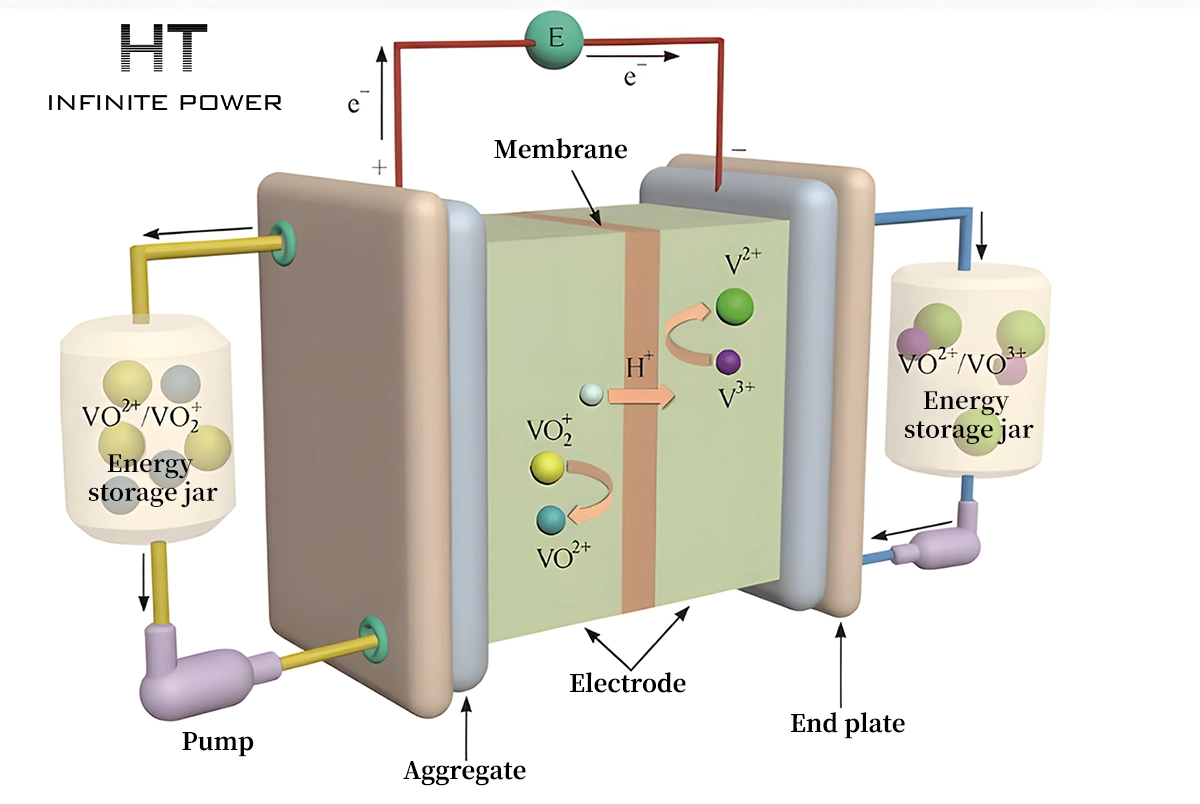
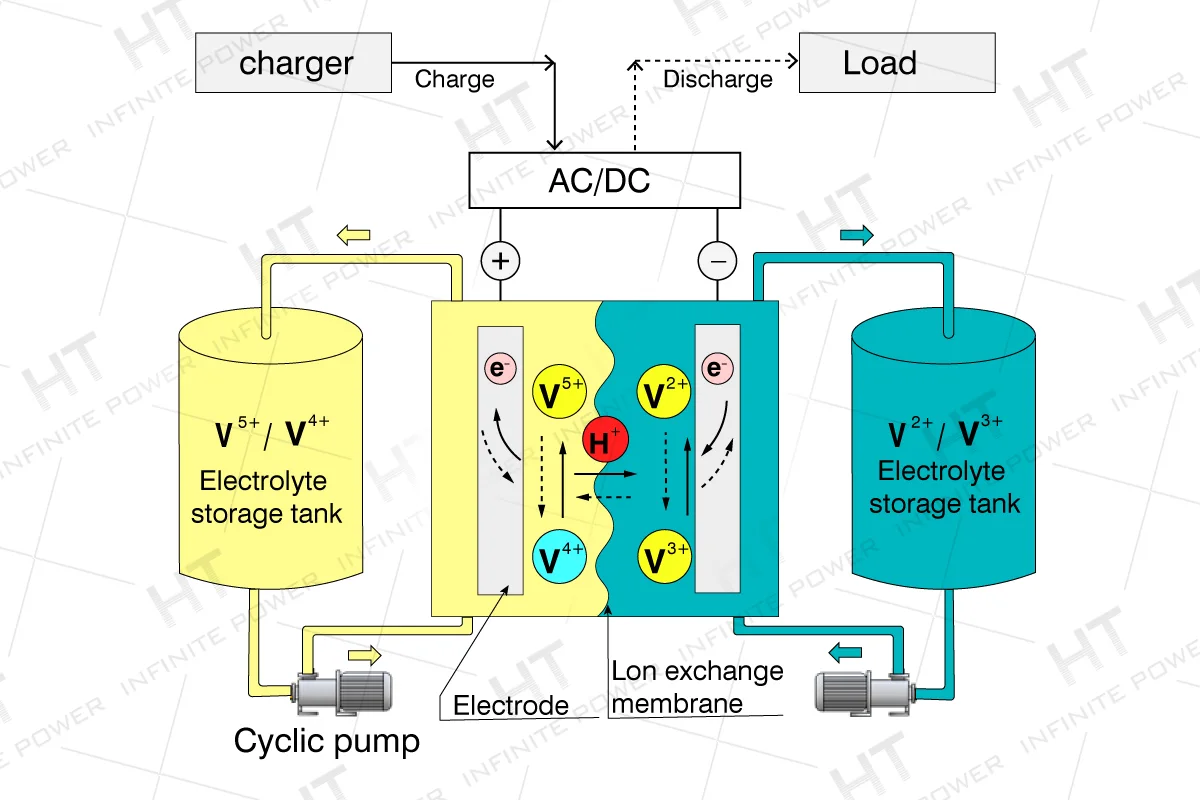
Figure 1 is a schematic diagram of the liquid flow battery and a schematic diagram of the battery stack structure. The positive and negative electrolytes of the battery are respectively stored in two storage tanks, and the electrolytes are circulated through the battery using a liquid pump. Inside the battery stack, the positive and negative electrolytes are separated by an ion exchange membrane (or ion diaphragm), and the battery is connected to an external load and power supply.
As a new type of large-scale and efficient electrochemical energy storage (electricity) technology, liquid flow battery technology realizes the mutual conversion and energy storage of electrical energy and chemical energy through the valence change of reactive substances. In liquid flow batteries, active substances are stored in electrolytes and have fluidity, which can realize the spatial separation of the electrochemical reaction site (electrode) and the energy storage active substance. The battery power and capacity design are relatively independent, which is suitable for large-scale power storage needs.
Unlike ordinary secondary batteries, the energy storage active materials of flow batteries are completely separated from the electrodes, and the power and capacity designs are independent of each other, which makes it easy to combine modules and place battery structures. The electrolyte is stored in a tank and will not self-discharge. The battery stack only provides a place for electrochemical reactions and does not undergo redox reactions itself. The active materials are dissolved in the electrolyte, and the risk of electrode dendrites growing and piercing the diaphragm is greatly reduced in the flow battery. At the same time, the flowing electrolyte can take away the heat generated by the battery charging/discharging process, avoiding damage to the battery structure or even combustion caused by battery heating.
Classification of flow batteries
Flow batteries can be divided into all-vanadium flow batteries, lithium-ion flow batteries and lead-acid flow batteries according to the different electrode active materials.

All-vanadium flow batteries are a new type of energy storage equipment. They can not only be used as energy storage devices for solar and wind power generation processes, but also for power grid peak regulation. Improve the stability of the power grid and ensure the safety of the power grid.
Zinc-bromine batteries are a type of flow energy storage battery, which has an inherent advantage in cost.
Lithium-ion flow batteries are the latest developed chemical energy storage battery technology. They combine the advantages of lithium-ion batteries and flow batteries. They are a new type of green rechargeable battery with independent output power and energy storage capacity, high energy density and low cost.
All-vanadium liquid flow battery
All-vanadium liquid flow battery (VRB, also often referred to as vanadium battery) was proposed by Marria Kazacos of the University of New South Wales, Australia in 1985.
As an electrochemical system, vanadium battery stores energy in an electrolyte containing redox pairs of vanadium ions with different valence states. Electrolytes with different redox pairs constitute the positive and negative electrolytes of the battery respectively, and the positive and negative electrolytes are separated by an ion exchange membrane. The solution is pressed from the reservoir into the battery stack through an external pump to complete the electrochemical reaction. After the reaction, the solution returns to the reservoir, and the active material circulates continuously, thereby completing the charge and discharge.
Compared with other energy storage batteries, all-vanadium flow batteries have the following characteristics:
(1) Controllable output power and energy storage capacity
The output power of the battery depends on the size and number of the battery stack, and the energy storage capacity depends on the capacity and concentration of the electrolyte. Therefore, its design is very flexible. To increase the output power, just increase the area and number of the battery stack. To increase the energy storage capacity, just increase the volume of the electrolyte.
(2) High safety
The existing battery system mainly uses aqueous solution as the electrolyte, and the battery system has no potential explosion or fire hazard.
(3) Fast start-up speed
If the battery stack is full of electrolyte, it can be started within 2 minutes. During operation, it only takes 0.02 seconds to switch the charge and discharge state.
(4) Good battery rate performance
The active material of the all-vanadium flow battery is vanadium ions of different valence states dissolved in aqueous solution. During the charge and discharge process of the all-vanadium flow battery, only the ion valence state changes, and no phase change reaction occurs. The charge and discharge response speed is fast.
(5) Long battery life
The electrolyte metal ion is only vanadium ion, so there will be no cross-contamination problem between the positive and negative electrolyte active substances. The battery has a long service life and the electrolyte solution is easy to regenerate and recycle.
(6) The battery self-discharge is controllable
When the system is in shutdown mode, the electrolyte in the tank will not self-discharge.
(7) Convenient manufacturing and placement
The wave flow battery has a large degree of freedom in site selection, and the system can be fully automatically closed and operated without pollution, simple maintenance, and low operating cost.
(8) Battery materials are easy to recycle and reuse
Liquid flow battery components are mostly cheap carbon materials and engineering plastics. The material sources are abundant, and there is no pollution during the recycling process. It is environmentally friendly and inexpensive. In addition, real-time monitoring of the battery system state of charge (SOC) is relatively easy, which is conducive to the management and dispatch of the power grid.
Lithium-ion flow battery
Working principle of lithium-ion flow battery
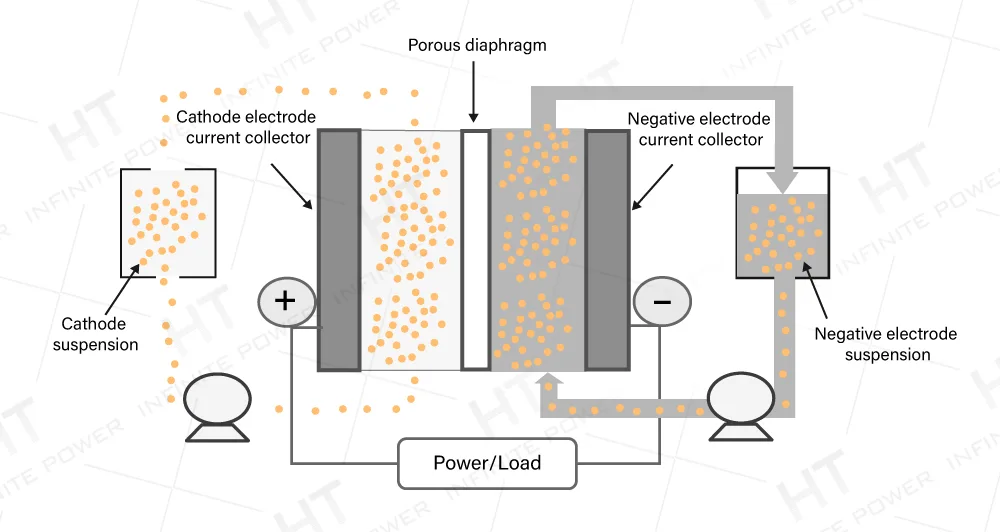
Lithium-ion flow battery is mainly composed of battery reactor, positive electrode suspension storage tank, negative electrode suspension storage tank, liquid pump and sealed pipe. Among them, the positive electrode suspension storage tank contains a mixture of positive electrode active material particles, conductive agent and electrolyte, and the negative electrode suspension storage tank contains a mixture of negative electrode active material particles, conductive agent and electrolyte. The battery reactor is the core of lithium-ion flow battery, and its structure mainly includes: positive electrode current collector, positive electrode reaction chamber, porous diaphragm, negative electrode reaction chamber, negative electrode current collector and shell. When lithium-ion flow battery is working, a liquid pump is used to circulate the suspension. The suspension flows continuously or intermittently between the suspension storage tank and the battery reactor through a sealed pipe driven by a liquid pump or other power. The flow rate can be adjusted according to the concentration of the suspension and the ambient temperature.
When the battery is working, the positive electrode suspension enters the positive electrode reaction chamber of the battery reactor from the positive electrode liquid inlet, and returns to the positive electrode suspension storage tank from the positive electrode liquid outlet through a sealed pipe after the reaction is completed. At the same time, the negative electrode suspension enters the negative electrode reaction chamber of the battery reactor from the negative electrode liquid inlet, and returns to the negative electrode suspension storage tank from the negative electrode liquid outlet through a sealed pipe after the reaction is completed. There is an electronically non-conductive porous diaphragm between the positive electrode reaction chamber and the negative electrode reaction chamber, which separates the positive electrode active material particles in the positive electrode suspension and the negative electrode active material particles in the negative electrode suspension from each other, avoiding direct contact between the positive and negative electrode active material particles and causing a short circuit inside the battery. The positive electrode suspension in the positive electrode reaction chamber and the negative electrode suspension in the negative electrode reaction chamber can be exchanged and transmitted with lithium ions through the electrolyte in the porous diaphragm.
When the battery is discharged, the lithium ions inside the negative electrode active material particles in the negative electrode reaction chamber are deintercalated, enter the electrolyte, and reach the positive electrode reaction chamber through the porous diaphragm, and are embedded in the positive electrode active material particles: at the same time, the electrons inside the negative electrode active material particles in the negative electrode reaction chamber flow into the negative electrode collector, and flow into the external circuit of the battery through the negative electrode tab of the negative electrode collector, and after completing the work, flow into the positive electrode collector through the positive plate tab, and finally embed into the positive electrode active material particles in the positive electrode reaction chamber. The battery charging process is the opposite.
In addition, there are many classifications of flow batteries, such as:

Zinc-bromine flow battery
Zinc-cerium flow battery
Zinc-nickel flow battery
Lead flow battery
Iron-chromium flow battery
Sodium polysulfide/bromine flow battery
Zinc-iron flow battery
Zinc-cerium flow battery
Zinc-nickel flow battery
Lead flow battery
Iron-chromium flow battery
Sodium polysulfide/bromine flow battery
Zinc-iron flow battery
Summary and Prospect of Flow Batteries
For traditional dual-flow batteries, while gradually realizing the commercialization of mature technologies such as all-vanadium flow batteries, it is a very meaningful and promising task to develop new electrode pairs and non-aqueous systems with the characteristics of high solubility, stable chemical properties, high reversibility of electrode reactions, no oxygen/hydrogen evolution side reactions, and large equilibrium potential difference of electrode pairs.
Compared with dual-flow batteries, deposition-type single-flow batteries have the characteristics of simplified structure, high specific energy, and low cost, but the capacity of single-flow batteries is limited by solid electrodes, and the life span needs to be improved. The uniformity and stability of deposition-type metal electrodes and the electrolyte that takes into account the performance of both positive and negative electrodes also need to be further resolved.

New flow battery technologies, such as vanadium/air flow batteries, (Fe3+/Fe2+) flow/methanol fuel cells, or semi-solid lithium-ion flow batteries, are in the initial stage of research. Whether in terms of performance, reliability, or cycle life, they cannot meet the needs of practical applications. Therefore, these new technologies still have a long way to go to become mature commercial technologies.
Large-scale, high-efficiency, low-cost, and long life are the development direction and goals of liquid flow energy storage battery technology in the future. Therefore, it is necessary to strengthen the research on key materials (such as electrolytes, ion exchange membranes, electrode materials, etc.) and battery structures of liquid flow energy storage batteries to improve battery reliability and durability. At the same time, large-scale production technology development of key materials should be carried out to significantly reduce the cost of key battery materials, and actively carry out application demonstrations to lay the foundation for the industrialization and large-scale application of liquid flow energy storage batteries.
What is supercapacitor energy storage and its application areas?
Hydrogen Energy Storage: The Future of Renewable Energy Solutions